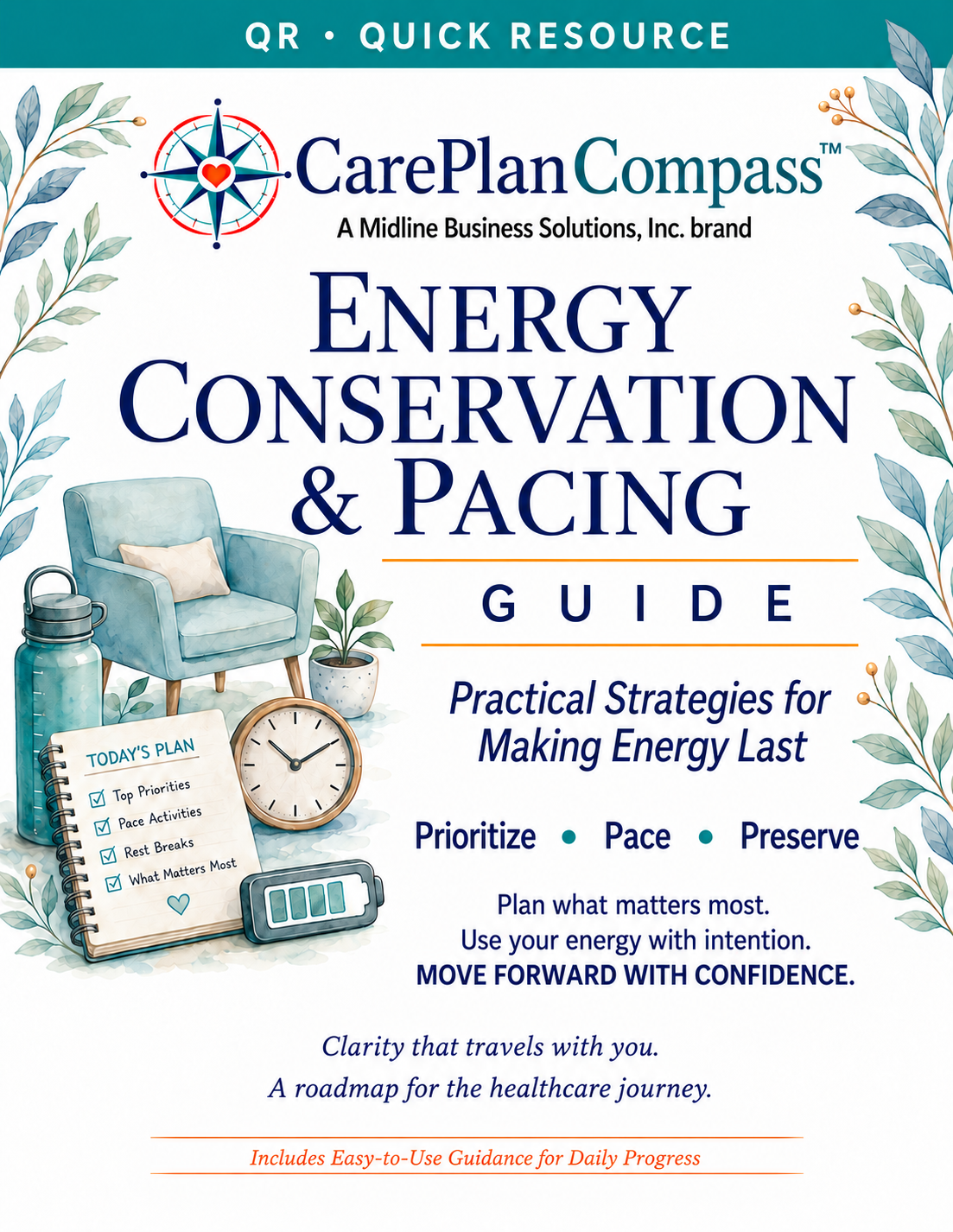
Energy Conservation & Pacing Guide

Guidance Resource

Energy Conservation & Pacing Guide

A practical guide to planning, prioritizing, pacing, positioning, simplifying daily tasks, and using rest more intentionally when energy is limited.

Format digital
Access Free / Access-Based
Item ID hmb009

Educational support only. This resource complements, not replaces, provider instructions, facility policy, or medical advice.

Item Details

About this resource

Start here

The essentials before you go deeper.

More details

The Energy Conservation & Pacing Guide helps people organize daily activities when fatigue, reduced endurance, pain, recovery, or a health condition makes ordinary tasks more demanding. It introduces practical approaches for planning the day, prioritizing essential activities, pacing effort, choosing supportive positions, simplifying tasks, organizing frequently used supplies, alternating heavier and lighter activities, and recognizing early signs that a rest break may be needed. The guide also includes activity-planning prompts, an energy-use check, and questions to discuss with the healthcare team. It is also part of the CarePlanCompass™ Guide Energy, Rest & Pacing. It is educational and organizational support and does not replace individualized medical, rehabilitation, or provider guidance.

energy conservation pacing fatigue management low endurance limited endurance activity tolerance activity planning work simplification task simplification rest breaks daily routine daily activities ADLs IADLs household tasks chronic illness chronic condition pain recovery post hospital recovery heart condition lung condition caregiver support home safety aging in place occupational therapy four Ps plan prioritize pace position

Next Step Hub

Your next best move starts here.

Choose the matched bundle, continue with this resource, review connected tools, or check the evidence behind the guidance.

Best matched next step

Lower Back Pain & Sciatica Bundle

Built for users who want this Companion plus the most useful connected supports in one organized pathway.

Lower Back Pain & Sciatica Companion Chronic Pain Management Companion Back & Joint Pain Tracker Questions for Your Orthopedic Provider
This resource

Continue with this item

Use this path when this resource is the book, guide, or support tool you came for.

Get Access

Connected Tools

Related pathway tools

8 items
Applied Companion Lower Back Pain & Sciatica Companion
View
Applied Companion Chronic Pain Management Companion
View
Guidance Resource Back & Joint Pain Tracker
View
Guidance Resource Questions for Your Orthopedic Provider
View
Guidance Resource Back & Joint Pain Red Flags
View
Guidance Resource Pain Neuroscience
View
View all related tools
Guidance Resource Pacing & Graded Return to Activity
View
Guidance Resource Joint-Friendly Movement Planner
View

Clinical Confidence

Evidence behind this resource

18 sources
Evidence-informed

Guidance is connected to the CarePlanCompass™ reference database.

AMA-style references

Sources are formatted for clinical review and transparency.

Methodology available

Users can review how references support the resource framework.

View Clinical Evidence & Methodology

View clinical references 18 sources
  1. Mathiowetz V, Matuska KM, Murphy ME. Efficacy of an energy conservation course for persons with multiple sclerosis. Arch Phys Med Rehabil. 2001;82(4):449-456. doi:10.1053/apmr.2001.22192
  2. Mathiowetz VG, Finlayson ML, Matuska KM, Chen HY, Luo P. Randomized controlled trial of an energy conservation course for persons with multiple sclerosis. Mult Scler. 2005;11(5):592-601.
  3. Asano M, Finlayson ML. Meta-analysis of three different types of fatigue management interventions for people with multiple sclerosis: exercise, education, and medication. Mult Scler Int. 2014;2014:798285. doi:10.1155/2014/798285 Source
  4. Wendebourg MJ, Heesen C, Finlayson M, Meyer B, Pöttgen J, Köpke S. Patient education for people with multiple sclerosis-associated fatigue: a systematic review. PLoS One. 2017;12(3):e0173025. doi:10.1371/journal.pone.0173025
  5. Salomè A, Sasso D’Elia T, Franchini G, Santilli V, Paolucci T. Occupational therapy in fatigue management in multiple sclerosis: an umbrella review. Mult Scler Int. 2019;2019:2027947. doi:10.1155/2019/2027947
  6. Blikman LJ, Huisstede BM, Kooijmans H, Stam HJ, Bussmann JB, van Meeteren J. Effectiveness of energy conservation treatment in reducing fatigue in multiple sclerosis: a systematic review and meta-analysis. Arch Phys Med Rehabil. 2013;94(7):1360-1376.
  7. Blikman LJM, van Meeteren J, Twisk JWR, et al. Energy conservation management for people with multiple sclerosis–related fatigue: who benefits?. Am J Occup Ther. 2019;73(4):7304205040. doi:10.5014/ajot.2019.032474
  8. Finlayson M, Preissner K, Cho C, Plow M. Randomized trial of a teleconference-delivered fatigue management program for people with multiple sclerosis. Mult Scler. 2011;17(9):1130-1140.
  9. Barsevick AM, Dudley W, Beck S, Sweeney C, Whitmer K, Nail L. A randomized clinical trial of energy conservation for patients with cancer-related fatigue. Cancer. 2004;100(6):1302-1310. doi:10.1002/cncr.20111
  10. Denlinger CS, Ligibel JA, Are M, et al. Survivorship: fatigue, version 1.2014. J Natl Compr Canc Netw. 2014;12(6):876-887. doi:10.6004/jnccn.2014.0082
  11. Furst GP, Gerber LH, Smith CC, Fisher S, Shulman B. A program for improving energy conservation behaviors in adults with rheumatoid arthritis. Am J Occup Ther. 1987;41(2):102-111.
  12. Kim YJ, Radloff JC, Crane PA, Bolin LP. Rehabilitation intervention for individuals with heart failure and fatigue to reduce fatigue impact: a feasibility study. Ann Rehabil Med. 2019;43(6):686-699. doi:10.5535/arm.2019.43.6.686
  13. American Occupational Therapy Association. Occupational Therapy Practice Framework: Domain and Process—Fourth Edition. Am J Occup Ther. 2020;74(Suppl 2):7412410010p1-7412410010p87. doi:10.5014/ajot.2020.74S2001 Source
  14. Velloso M, Jardim JR. Study of energy expenditure during activities of daily living using and not using body position recommended by energy conservation techniques in patients with COPD. Chest. 2006;130(1):126-132. doi:10.1378/chest.130.1.126
  15. Nielson WR, Jensen MP, Karsdorp PA, Vlaeyen JWS. Activity pacing in chronic pain: concepts, evidence, and future directions. Clin J Pain. 2013;29(5):461-468. doi:10.1097/AJP.0b013e3182608561
  16. Antcliff D, Keenan AM, Keeley P, Woby S, McGowan L. Engaging stakeholders to refine an activity pacing framework for chronic pain/fatigue: a nominal group technique. Musculoskeletal Care. 2019;17(4):354-362. doi:10.1002/msc.1430
  17. National Institute for Health and Care Excellence. Myalgic encephalomyelitis (or encephalopathy)/chronic fatigue syndrome: diagnosis and management. NICE guideline NG206. NICE. 2021;Published October 29, 2021. Accessed October 7, 2026. https://www.nice.org.uk/guidance/ng206 Source
  18. Parker M, Brady Sawant H, Flannery T, et al. Effect of using a structured pacing protocol on post-exertional symptom exacerbation and health status in a longitudinal cohort with the post-COVID-19 syndrome. J Med Virol. 2023;95(1):e28373. doi:10.1002/jmv.28373

CarePlanCompass™"

Clarity that travels with you.

CarePlanCompass™ resources are designed to complement provider instructions, improve follow-through, and help people ask better questions at the right time.