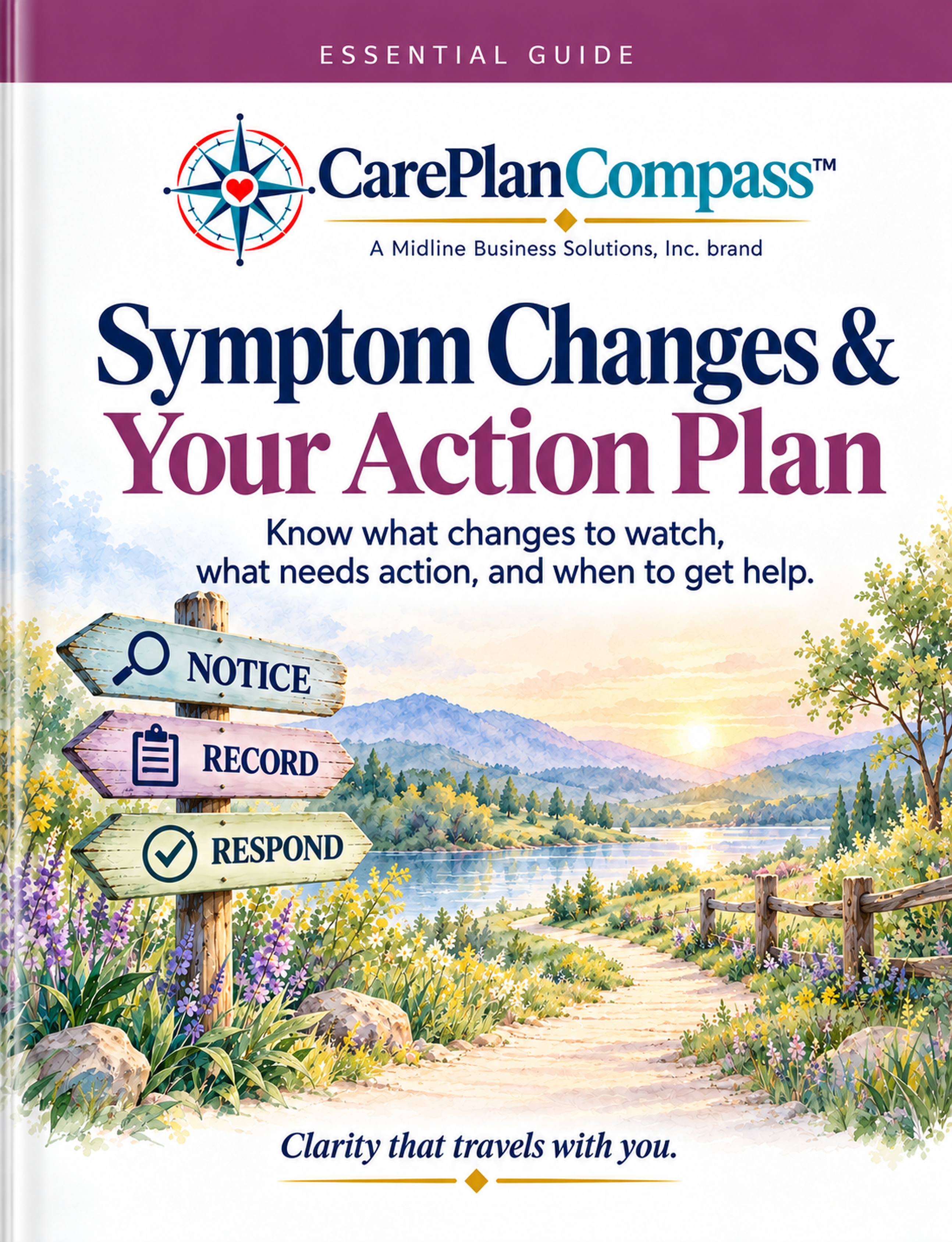
Symptom Changes & Your Action Plan

CarePlanCompass™ Resource

Symptom Changes & Your Action Plan

A practical guide to understanding symptom changes and keeping a written action plan for hard days and flare-ups.

Format digital
Access $9.00
Item ID grp003

Educational support only. This resource complements, not replaces, provider instructions, facility policy, or medical advice.

Item Details

About this resource

Start here

The essentials before you go deeper.

More details

Symptom Changes & Your Action Plan is a CarePlanCompass™ Guide that helps readers recognize symptom changes and follow a written plan for flare-ups and hard days. It brings together two core chapters, moving from understanding what matters, to putting it into practice, to tools and writing space. Topics include Symptom Guide & Red Flags and Flare-Up Protocol. References are listed at the end, and the Guide pairs well with the Chronic Pain Management Companion. It is educational and organizational support and does not replace individualized medical, rehabilitation, or emergency care.

symptom changes warning signs red flags when to call the doctor flare-up plan action plan chronic condition symptom tracking self-management care team communication emergency signs

Next Step Hub

Your next best move starts here.

Choose the matched bundle, continue with this resource, review connected tools, or check the evidence behind the guidance.

This resource

Continue with this item

Use this path when this resource is the book, guide, or support tool you came for.

Get Access

Clinical Confidence

Evidence behind this resource

10 sources
Evidence-informed

Guidance is connected to the CarePlanCompass™ reference database.

AMA-style references

Sources are formatted for clinical review and transparency.

Methodology available

Users can review how references support the resource framework.

View Clinical Evidence & Methodology

View clinical references 10 sources
  1. Bodenheimer T, Lorig K, Holman H, Grumbach K. Patient self-management of chronic disease in primary care. JAMA. 2002;288(19):2469-2475. doi:10.1001/jama.288.19.2469 Source
  2. Lorig KR, Holman HR. Self-management education: history, definition, outcomes, and mechanisms. Ann Behav Med. 2003;26(1):1-7. doi:10.1207/S15324796ABM2601_01
  3. American Occupational Therapy Association. Occupations and everyday activities. AOTA;Accessed October 15, 2026. https://www.aota.org/practice/domain-and-process/occupations-everyday-activities Source
  4. American Occupational Therapy Association. Occupational Therapy Practice Framework: Domain and Process—Fourth Edition. Am J Occup Ther. 2020;74(Suppl 2):7412410010p1-7412410010p87. doi:10.5014/ajot.2020.74S2001 Source
  5. Kessels RPC. Patients' memory for medical information. J R Soc Med. 2003;96(5):219-222. doi:10.1258/jrsm.96.5.219
  6. Harkin B, Webb TL, Chang BPI, et al. Does monitoring goal progress promote goal attainment? A meta-analysis of the experimental evidence. Psychol Bull. 2016;142(2):198-229. doi:10.1037/bul0000025
  7. Handley M, MacGregor K, Schillinger D, Sharifi C, Wong S, Bodenheimer T. Using action plans to help primary care patients adopt healthy behaviors: a descriptive study. J Am Board Fam Med. 2006;19(3):224-231. doi:10.3122/jabfm.19.3.224
  8. Howcroft M, Walters EH, Wood-Baker R, Walters JAE. Action plans with brief patient education for exacerbations in chronic obstructive pulmonary disease. Cochrane Database Syst Rev. 2016;(12):CD005074. doi:10.1002/14651858.CD005074.pub4
  9. Agency for Healthcare Research and Quality. Be more engaged in your healthcare. AHRQ;Updated November 2024. Accessed October 15, 2026. https://www.ahrq.gov/questions/be-engaged/index.html Source
  10. MedlinePlus Medical Encyclopedia. Recognizing medical emergencies. National Library of Medicine;Reviewed January 8, 2025. Accessed October 16, 2026. https://medlineplus.gov/ency/article/001927.htm Source

CarePlanCompass™"

Clarity that travels with you.

CarePlanCompass™ resources are designed to complement provider instructions, improve follow-through, and help people ask better questions at the right time.