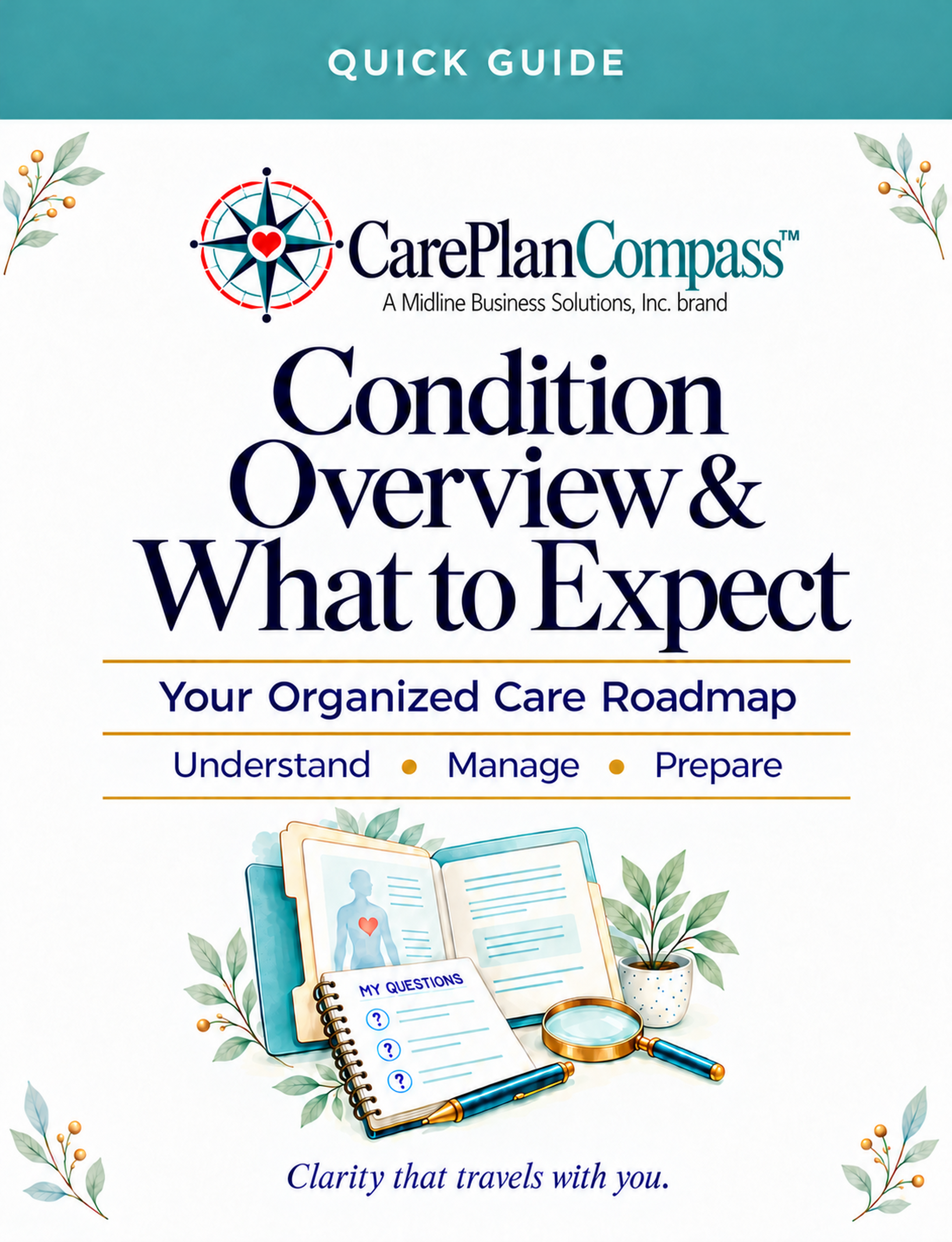
Condition Overview & What to Expect

Guidance Resource

Condition Overview & What to Expect

A plain-language guide to understanding a health condition, what may change over time, and the questions to bring to your care team.

Format digital
Access Free / Access-Based
Item ID dcm001

Educational support only. This resource complements, not replaces, provider instructions, facility policy, or medical advice.

Item Details

About this resource

Start here

The essentials before you go deeper.

More details

The Condition Overview & What to Expect guide helps people make sense of a new or ongoing health condition in plain language. It gives the reader one place to record what the condition is called, what may cause it, what tends to make it better or worse, how it may feel from day to day, and which changes the care team has said to watch for. It also includes space for visit schedules and questions to ask the healthcare team. The guide works alongside any CarePlanCompass™ Companion or condition resource. It is also part of the CarePlanCompass™ Guide Understanding Your Care Visits. It is educational and organizational support and does not replace individualized medical, rehabilitation, or provider guidance.

condition overview what to expect new diagnosis understanding my condition chronic condition chronic illness health condition basics plain language health patient education symptoms over time questions for my doctor care team communication visit preparation caregiver support disease management condition management

Next Step Hub

Your next best move starts here.

Choose the matched bundle, continue with this resource, review connected tools, or check the evidence behind the guidance.

Best matched next step

Stroke Bundle

Built for users who want this Companion plus the most useful connected supports in one organized pathway.

Stroke Recovery Companion Cognitive Rehabilitation Companion Symptom Guide & Red Flags Daily Management & Routine Planner
This resource

Continue with this item

Use this path when this resource is the book, guide, or support tool you came for.

Get Access

Connected Tools

Related pathway tools

8 items
Applied Companion Stroke Recovery Companion
View
Applied Companion Cognitive Rehabilitation Companion
View
Guidance Resource Symptom Guide & Red Flags
View
Guidance Resource Daily Management & Routine Planner
View
Guidance Resource Pain Neuroscience
View
Guidance Resource Cognitive Load Management
View
View all related tools
Guidance Resource Self-Management Toolkit
View
Guidance Resource Sensory Awareness & Risk Prevention
View

Clinical Confidence

Evidence behind this resource

10 sources
Evidence-informed

Guidance is connected to the CarePlanCompass™ reference database.

AMA-style references

Sources are formatted for clinical review and transparency.

Methodology available

Users can review how references support the resource framework.

View Clinical Evidence & Methodology

View clinical references 10 sources
  1. Kessels RPC. Patients' memory for medical information. J R Soc Med. 2003;96(5):219-222. doi:10.1258/jrsm.96.5.219
  2. Agency for Healthcare Research and Quality. Be more engaged in your healthcare. AHRQ;Updated November 2024. Accessed October 15, 2026. https://www.ahrq.gov/questions/be-engaged/index.html Source
  3. Elwyn G, Frosch D, Thomson R, et al. Shared decision making: a model for clinical practice. J Gen Intern Med. 2012;27(10):1361-1367. doi:10.1007/s11606-012-2077-6
  4. American Occupational Therapy Association. Occupations and everyday activities. AOTA;Accessed October 15, 2026. https://www.aota.org/practice/domain-and-process/occupations-everyday-activities Source
  5. American Occupational Therapy Association. Occupational Therapy Practice Framework: Domain and Process—Fourth Edition. Am J Occup Ther. 2020;74(Suppl 2):7412410010p1-7412410010p87. doi:10.5014/ajot.2020.74S2001 Source
  6. Kinnersley P, Edwards A, Hood K, et al. Interventions before consultations for helping patients address their information needs. Cochrane Database Syst Rev. 2007;(3):CD004565. doi:10.1002/14651858.CD004565.pub2
  7. Agency for Healthcare Research and Quality. Use the teach-back method: tool 5. Health Literacy Universal Precautions Toolkit. 3rd ed;Updated April 2024. Accessed October 15, 2026. https://www.ahrq.gov/health-literacy/improve/precautions/tool5.html Source
  8. National Library of Medicine. Understanding medical words tutorial. MedlinePlus;Updated September 30, 2024. Accessed October 15, 2026. https://medlineplus.gov/medicalwords.html Source
  9. Lorig KR, Holman HR. Self-management education: history, definition, outcomes, and mechanisms. Ann Behav Med. 2003;26(1):1-7. doi:10.1207/S15324796ABM2601_01
  10. Talevski J, Wong Shee A, Rasmussen B, et al. Teach-back: a systematic review of implementation and impacts. PLoS One. 2020;15(4):e0231350. doi:10.1371/journal.pone.0231350

CarePlanCompass™"

Clarity that travels with you.

CarePlanCompass™ resources are designed to complement provider instructions, improve follow-through, and help people ask better questions at the right time.