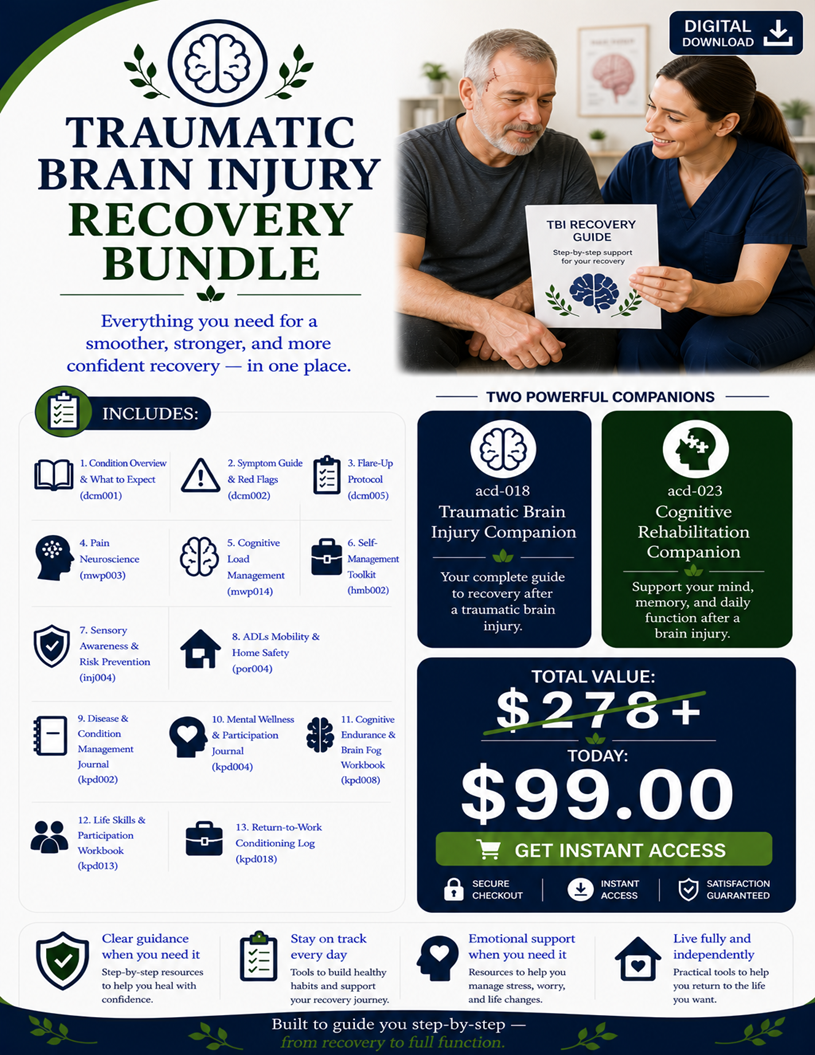
Traumatic Brain Injury Bundle

Bundle

Traumatic Brain Injury Bundle

A focused CarePlanCompass™ support resource designed to improve clarity, follow-through, and next-step confidence.
Format digital
Access $99.00
Item ID bndl018

Educational support only. This resource complements, not replaces, provider instructions, facility policy, or medical advice.

Item Details

About this resource

Start here

The essentials before you go deeper.

More details

A focused CarePlanCompass™ support resource designed to improve clarity, follow-through, and next-step confidence.

Bundle Contents

Included in this bundle

This bundle includes the following companions, guidance resources, and workbook tools from the bundle matrix.

acd018 Traumatic Brain Injury Companion
acd023 Cognitive Rehabilitation Companion
dcm001 Condition Overview & What to Expect
dcm002 Symptom Guide & Red Flags
dcm005 Flare-Up Action Plan
mwp003 Pain Neuroscience
mwp014 Cognitive Load Management
hmb002 Self-Management Toolkit
inj004 Sensory Awareness & Risk Prevention
por004 ADLs Mobility & Home Safety
kpd002 Daily Health Journal
kpd004 Mood & Mindset Journal
kpd008 Cognitive Endurance & Brain Fog Workbook
kpd013 Life Skills & Participation Workbook
kpd018 Return-to-Work Conditioning Log

Next Step Hub

Your next best move starts here.

Choose the matched bundle, continue with this resource, review connected tools, or check the evidence behind the guidance.

This resource

Continue with this item

Use this path when this resource is the book, guide, or support tool you came for.

Get Access

Clinical Confidence

Evidence behind this resource

50 sources
Evidence-informed

Guidance is connected to the CarePlanCompass™ reference database.

AMA-style references

Sources are formatted for clinical review and transparency.

Methodology available

Users can review how references support the resource framework.

View Clinical Evidence & Methodology

View clinical references 50 sources
  1. Bayley MT, et al. INCOG 2.0 guidelines for cognitive rehabilitation following traumatic brain injury, Part I: posttraumatic amnesia. Journal of Head Trauma Rehabilitation. 2023;38(1):1-14. https://journals.lww.com/headtraumarehab/fulltext/2023/01000/incog_2_0_guidelines_for_cognitive_rehabilitation.2.aspx Source
  2. U.S. Department of Veterans Affairs; U.S. Department of Defense. VA/DoD clinical practice guideline for the management and rehabilitation of post-acute mild traumatic brain injury. VA/DoD Clinical Practice Guideline. 2021;Version 3.0, June 2021. https://www.healthquality.va.gov/guidelines/Rehab/mtbi/VADODmTBICPGFinal508.pdf Source
  3. Kessels RPC. Patients' memory for medical information. J R Soc Med. 2003;96(5):219-222. doi:10.1258/jrsm.96.5.219
  4. Ponsford J, et al. INCOG 2.0 guidelines for cognitive rehabilitation following traumatic brain injury, Part II: attention and information processing speed. Journal of Head Trauma Rehabilitation. 2023;38(1):15-27. https://pubmed.ncbi.nlm.nih.gov/36594857/ Source
  5. Lumba-Brown A, Yeates KO, Sarmiento K, et al. Centers for Disease Control and Prevention guideline on the diagnosis and management of mild traumatic brain injury among children. JAMA Pediatrics. 2018;172(11):e182853. doi:10.1001/jamapediatrics.2018.2853 Source
  6. Agency for Healthcare Research and Quality. Be more engaged in your healthcare. AHRQ;Updated November 2024. Accessed October 15, 2026. https://www.ahrq.gov/questions/be-engaged/index.html Source
  7. Bayley MT, et al. INCOG 2.0 guidelines for cognitive rehabilitation following traumatic brain injury, Part I: posttraumatic amnesia. Journal of Head Trauma Rehabilitation. 2023;38(1):1-14. https://journals.lww.com/headtraumarehab/fulltext/2023/01000/incog_2_0_guidelines_for_cognitive_rehabilitation.2.aspx Source
  8. Jeffay E, et al. INCOG 2.0 guidelines for cognitive rehabilitation following traumatic brain injury, Part III: executive functions. Journal of Head Trauma Rehabilitation. 2023;38(1):28-47. https://journals.lww.com/headtraumarehab/fulltext/2023/01000/incog_2_0_guidelines_for_cognitive_rehabilitation.5.aspx Source
  9. Elwyn G, Frosch D, Thomson R, et al. Shared decision making: a model for clinical practice. J Gen Intern Med. 2012;27(10):1361-1367. doi:10.1007/s11606-012-2077-6
  10. Ponsford J, et al. INCOG 2.0 guidelines for cognitive rehabilitation following traumatic brain injury, Part II: attention and information processing speed. Journal of Head Trauma Rehabilitation. 2023;38(1):15-27. https://pubmed.ncbi.nlm.nih.gov/36594857/ Source
  11. Velikonja D, et al. INCOG 2.0 guidelines for cognitive rehabilitation following traumatic brain injury, Part IV: cognitive-communication and social cognition disorders. Journal of Head Trauma Rehabilitation. 2023;38(1):48-65. https://pubmed.ncbi.nlm.nih.gov/36594859/ Source
  12. American Occupational Therapy Association. Occupations and everyday activities. AOTA;Accessed October 15, 2026. https://www.aota.org/practice/domain-and-process/occupations-everyday-activities Source
  13. Jeffay E, et al. INCOG 2.0 guidelines for cognitive rehabilitation following traumatic brain injury, Part III: executive functions. Journal of Head Trauma Rehabilitation. 2023;38(1):28-47. https://journals.lww.com/headtraumarehab/fulltext/2023/01000/incog_2_0_guidelines_for_cognitive_rehabilitation.5.aspx Source
  14. Kennedy MRT, et al. INCOG 2.0 guidelines for cognitive rehabilitation following traumatic brain injury, Part V: memory. Journal of Head Trauma Rehabilitation. 2023;38(1):66-85. https://pubmed.ncbi.nlm.nih.gov/36594860/ Source
  15. American Occupational Therapy Association. Occupational Therapy Practice Framework: Domain and Process—Fourth Edition. Am J Occup Ther. 2020;74(Suppl 2):7412410010p1-7412410010p87. doi:10.5014/ajot.2020.74S2001 Source
  16. Velikonja D, et al. INCOG 2.0 guidelines for cognitive rehabilitation following traumatic brain injury, Part IV: cognitive-communication and social cognition disorders. Journal of Head Trauma Rehabilitation. 2023;38(1):48-65. https://pubmed.ncbi.nlm.nih.gov/36594859/ Source
  17. Cicerone KD, Goldin Y, Ganci K, et al. Evidence-based cognitive rehabilitation: systematic review of the literature from 2009 through 2014. Archives of Physical Medicine and Rehabilitation. 2019;100(8):1515-1533. doi:10.1016/j.apmr.2019.02.011 Source
  18. Kinnersley P, Edwards A, Hood K, et al. Interventions before consultations for helping patients address their information needs. Cochrane Database Syst Rev. 2007;(3):CD004565. doi:10.1002/14651858.CD004565.pub2
  19. Kennedy MRT, et al. INCOG 2.0 guidelines for cognitive rehabilitation following traumatic brain injury, Part V: memory. Journal of Head Trauma Rehabilitation. 2023;38(1):66-85. https://pubmed.ncbi.nlm.nih.gov/36594860/ Source
  20. Toglia J, Foster ER. The multicontext approach to cognitive rehabilitation: a metacognitive strategy intervention to optimize functional cognition. AOTA Press. 2021;2nd edition. https://library.aota.org/AOTA-Press/Product/900520 Source
  21. Agency for Healthcare Research and Quality. Use the teach-back method: tool 5. Health Literacy Universal Precautions Toolkit. 3rd ed;Updated April 2024. Accessed October 15, 2026. https://www.ahrq.gov/health-literacy/improve/precautions/tool5.html Source
  22. Centers for Disease Control and Prevention. About traumatic brain injury. Centers for Disease Control and Prevention. 2025. https://www.cdc.gov/traumatic-brain-injury/about/index.html Source
  23. American Congress of Rehabilitation Medicine Cognitive Rehabilitation Task Force. Cognitive rehabilitation manual: translating evidence-based recommendations into practice. American Congress of Rehabilitation Medicine. 2022;Second edition. https://acrm.org/publications/cognitive-rehabilitation-manual/ Source
  24. National Library of Medicine. Understanding medical words tutorial. MedlinePlus;Updated September 30, 2024. Accessed October 15, 2026. https://medlineplus.gov/medicalwords.html Source
  25. Centers for Disease Control and Prevention. HEADS UP: concussion signs and symptoms. Centers for Disease Control and Prevention. 2025. https://www.cdc.gov/heads-up/signs-symptoms/index.html Source
  26. American Speech-Language-Hearing Association. Traumatic brain injury in adults. ASHA Practice Portal. 2025. https://www.asha.org/practice-portal/clinical-topics/traumatic-brain-injury-in-adults/ Source
  27. Lorig KR, Holman HR. Self-management education: history, definition, outcomes, and mechanisms. Ann Behav Med. 2003;26(1):1-7. doi:10.1207/S15324796ABM2601_01
  28. American Speech-Language-Hearing Association. Dementia. ASHA Practice Portal. 2025. https://www.asha.org/practice-portal/clinical-topics/dementia/ Source
  29. Talevski J, Wong Shee A, Rasmussen B, et al. Teach-back: a systematic review of implementation and impacts. PLoS One. 2020;15(4):e0231350. doi:10.1371/journal.pone.0231350
  30. Ontario Neurotrauma Foundation. Guideline for concussion/mild traumatic brain injury and persistent symptoms. Ontario Neurotrauma Foundation. 2018;3rd edition. https://concussionsontario.org/sites/default/files/2023-03/Third_Edition.pdf Source
  31. American Occupational Therapy Association. Occupational Therapy Practice Framework: Domain and Process—Fourth Edition. Am J Occup Ther. 2020;74(Suppl 2):7412410010p1-7412410010p87. doi:10.5014/ajot.2020.74S2001 Source
  32. Marshall S, Bayley M, McCullagh S, et al. Clinical practice guidelines for mild traumatic brain injury and persistent symptoms. Canadian Family Physician. 2012;58(3):257-267. https://pmc.ncbi.nlm.nih.gov/articles/PMC3303645/ Source
  33. American Speech-Language-Hearing Association. Traumatic brain injury in adults. ASHA Practice Portal. 2025. https://www.asha.org/practice-portal/clinical-topics/traumatic-brain-injury-in-adults/ Source
  34. Giles GM, Edwards DF, Morrison MT, et al. Screening and assessment of cognitive dysfunction in adults with traumatic brain injury: a systematic review. Am J Occup Ther. 2020;74(2):7402205010p1-7402205010p14. doi:10.5014/ajot.2020.038182 Source
  35. Giles GM, Edwards DF, Morrison MT, et al. Intervention for cognitive dysfunction in adults with traumatic brain injury: a systematic review. Am J Occup Ther. 2020;74(2):7402205020p1-7402205020p9. doi:10.5014/ajot.2020.038190 Source
  36. Mucha A, et al. A brief vestibular/ocular motor screening assessment to evaluate concussions. American Journal of Sports Medicine. 2014;42(10):2479-2486. doi:10.1177/0363546514543775 Source
  37. Benedict RHB, Amato MP, DeLuca J, Geurts JJG. Cognitive impairment in multiple sclerosis: clinical management, MRI, and therapeutic avenues. Lancet Neurology. 2020;19(10):860-871. doi:10.1016/S1474-4422(20)30277-5 Source
  38. Schneider KJ, et al. Cervicovestibular rehabilitation in sport-related concussion: a randomised controlled trial. British Journal of Sports Medicine. 2014;48(17):1294-1298. doi:10.1136/bjsports-2013-093267 Source
  39. Bakas T, et al. Systematic review of the evidence for stroke family caregiver and dyad interventions. Stroke. 2022. doi:10.1161/STROKEAHA.121.034090 Source
  40. Theadom A, Barker-Collo S, Jones K, et al. Work limitations four years after mild traumatic brain injury: a cohort study. Archives of Physical Medicine and Rehabilitation. 2017;98(8):1560-1566. doi:10.1016/j.apmr.2017.01.010 Source
  41. Smallfield S, Fang L, Kyler D. Self-management interventions to improve activities of daily living and rest and sleep for adults with chronic conditions: a systematic review. Am J Occup Ther. 2021;75(4):7504190010. doi:10.5014/ajot.2021.046946 Source
  42. Kreutzer JS, Rapport LJ, Marwitz JH, et al. Caregivers’ well-being after traumatic brain injury: a multicenter prospective investigation. Archives of Physical Medicine and Rehabilitation. 2009;90(6):939-946. doi:10.1016/j.apmr.2009.01.010 Source
  43. Maski K, Trotti LM, Kotagal S, et al. Treatment of central disorders of hypersomnolence: an American Academy of Sleep Medicine clinical practice guideline. Journal of Clinical Sleep Medicine. 2021;17(9):1881-1893. doi:10.5664/jcsm.9328 Source
  44. U.S. Department of Veterans Affairs. Traumatic brain injury: a guide for caregivers of service members and veterans. VA Polytrauma/TBI System of Care. 2020;2nd edition. https://www.polytrauma.va.gov/downloads/TBICaregiverGuide.pdf Source
  45. Harvard Medical School Division of Sleep Medicine. Safety. Harvard Medical School Sleep and Health Education Program. 2025. https://sleep.hms.harvard.edu/education-training/public-education/sleep-and-health-education-program/sleep-health-education-8 Source
  46. Silver JM, McAllister TW, Arciniegas DB. Depression and cognitive complaints following mild traumatic brain injury. American Journal of Psychiatry. 2009;166(6):653-661. doi:10.1176/appi.ajp.2009.08111676 Source
  47. American Occupational Therapy Association. Occupational Therapy Practice Framework: Domain and Process—Fourth Edition. Am J Occup Ther. 2020;74(Suppl 2):7412410010p1-7412410010p87. doi:10.5014/ajot.2020.74S2001 Source
  48. McCall CA, Watson NF. Therapeutic strategies for mitigating driving risk in patients with narcolepsy. Nature and Science of Sleep. 2020;12:1047-1056. doi:10.2147/NSS.S266067 Source
  49. National Institute of Neurological Disorders and Stroke. Narcolepsy. National Institute of Neurological Disorders and Stroke. 2025. https://www.ninds.nih.gov/health-information/disorders/narcolepsy Source
  50. Smallfield S, Fang L, Kyler D. Self-management interventions to improve activities of daily living and rest and sleep for adults with chronic conditions: a systematic review. Am J Occup Ther. 2021;75(4):7504190010. doi:10.5014/ajot.2021.046946 Source

CarePlanCompass™"

Clarity that travels with you.

CarePlanCompass™ resources are designed to complement provider instructions, improve follow-through, and help people ask better questions at the right time.