Autism Bundle

Bundle

Autism Bundle

A focused CarePlanRx™ support resource designed to improve clarity, follow-through, and next-step confidence.
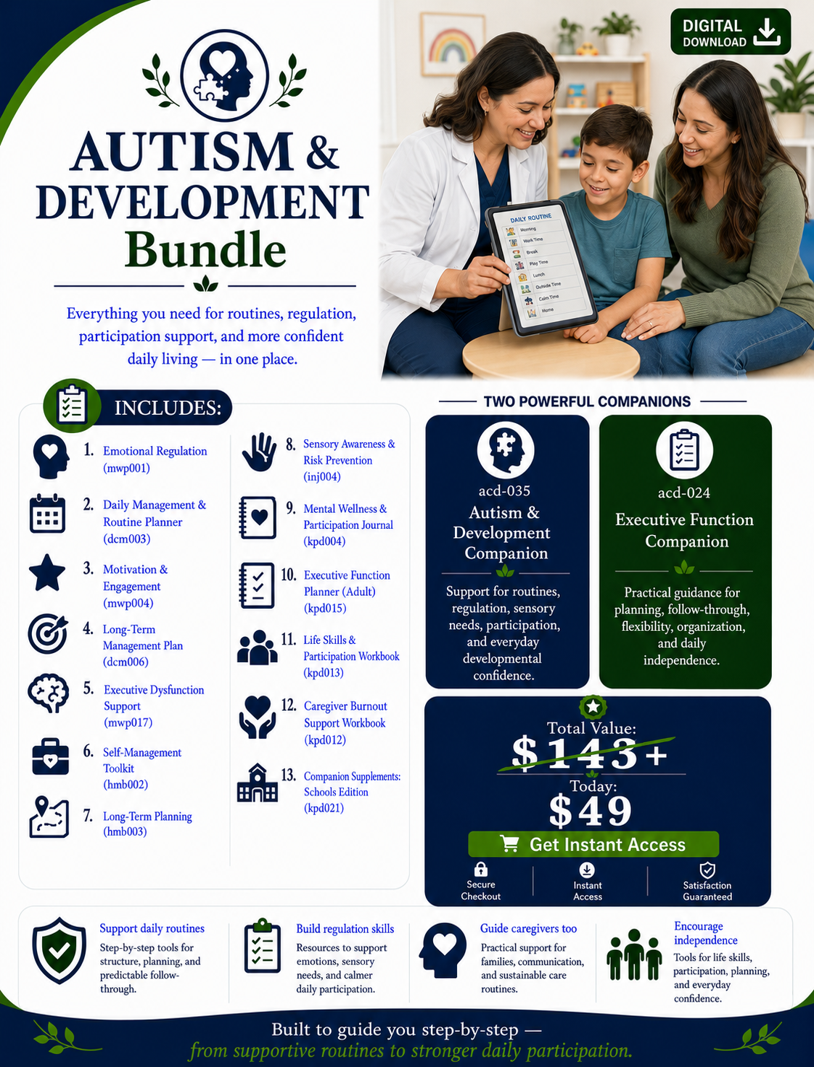
Format digital
Access $49.00
Item ID bndl-035

Educational support only. This resource complements, not replaces, provider instructions, facility policy, or medical advice.

Item Details

About this resource

Start here

The essentials before you go deeper.

More details

A focused CarePlanRx™ support resource designed to improve clarity, follow-through, and next-step confidence.

Bundle Contents

Included in this bundle

This bundle includes the following companions, guidance resources, and workbook tools from the bundle matrix.

acd-035 Autism & Development Companion
acd-024 Executive Function Companion
mwp001 Emotional Regulation
dcm003 Daily Management & Routine Planner
mwp004 Motivation & Engagement
dcm006 Long-Term Management Plan
mwp017 Executive Dysfunction Support
hmb002 Self-Management Toolkit
hmb003 Long-Term Planning
inj004 Sensory Awareness & Risk Prevention
kpd004 Mental Wellness & Participation Journal
kpd015 Executive Function Planner (Adult)
kpd013 Life Skills & Participation Workbook
kpd012 Caregiver Burnout Support Workbook
kpd021 Companion Supplements: Schools Edition

Next Step Hub

Your next best move starts here.

Choose the matched bundle, continue with this resource, review connected tools, or check the evidence behind the guidance.

This resource

Continue with this item

Use this path when this resource is the book, guide, or support tool you came for.

Get Access

Clinical Confidence

Evidence behind this resource

40 sources
Evidence-informed

Guidance is connected to the CarePlanRx™ reference database.

AMA-style references

Sources are formatted for clinical review and transparency.

Methodology available

Users can review how references support the resource framework.

View Clinical Evidence & Methodology

View clinical references 40 sources
  1. American Speech-Language-Hearing Association. Executive function deficits. ASHA Practice Portal. 2025. https://www.asha.org/practice-portal/clinical-topics/executive-function-deficits/ Source
  2. Patten KK, Murthi K, Onwumere DD, et al. Occupational therapy practice guidelines for autistic people across the lifespan. American Journal of Occupational Therapy. 2024;78(3):7803397010. https://research.aota.org/ajot/article/78/3/7803397010/25188/Occupational-Therapy-Practice-Guidelines-for Source
  3. American Occupational Therapy Association. Functional cognition. American Occupational Therapy Association. 2025. https://www.aota.org/practice/clinical-topics/functional-cognition Source
  4. National Institute for Health and Care Excellence. Autism spectrum disorder in adults: diagnosis and management. NICE guideline CG142. NICE Guideline. 2012;CG142; last updated June 14, 2021; last reviewed September 5, 2025. https://www.nice.org.uk/guidance/cg142 Source
  5. Jeffay E, et al. INCOG 2.0 guidelines for cognitive rehabilitation following traumatic brain injury, Part III: executive functions. Journal of Head Trauma Rehabilitation. 2023;38(1):28-47. https://journals.lww.com/headtraumarehab/fulltext/2023/01000/incog_2_0_guidelines_for_cognitive_rehabilitation.5.aspx Source
  6. National Institute for Health and Care Excellence. Autism spectrum disorder in under 19s: support and management. NICE guideline CG170. NICE Guideline. 2013;CG170; last updated June 14, 2021. https://www.nice.org.uk/guidance/cg170 Source
  7. Ponsford J, et al. INCOG 2.0 guidelines for cognitive rehabilitation following traumatic brain injury, Part II: attention and information processing speed. Journal of Head Trauma Rehabilitation. 2023;38(1):15-27. https://pubmed.ncbi.nlm.nih.gov/36594857/ Source
  8. National Institute for Health and Care Excellence. Autism spectrum disorder in under 19s: recognition, referral and diagnosis. NICE guideline CG128. NICE Guideline. 2011;CG128; last updated December 20, 2017. https://www.nice.org.uk/guidance/cg128 Source
  9. Kennedy MRT, et al. INCOG 2.0 guidelines for cognitive rehabilitation following traumatic brain injury, Part V: memory. Journal of Head Trauma Rehabilitation. 2023;38(1):66-85. https://pubmed.ncbi.nlm.nih.gov/36594860/ Source
  10. American Occupational Therapy Association. Occupational Therapy Practice Framework: Domain and Process—Fourth Edition. American Journal of Occupational Therapy. 2020;74(Suppl 2):7412410010p1-7412410010p87. doi:10.5014/ajot.2020.74S2001 Source
  11. World Health Organization. Autism. World Health Organization Fact Sheet. 2025;Updated September 17, 2025. https://www.who.int/news-room/fact-sheets/detail/autism-spectrum-disorders Source
  12. Velikonja D, et al. INCOG 2.0 guidelines for cognitive rehabilitation following traumatic brain injury, Part IV: cognitive-communication and social cognition disorders. Journal of Head Trauma Rehabilitation. 2023;38(1):48-65. https://pubmed.ncbi.nlm.nih.gov/36594859/ Source
  13. Centers for Disease Control and Prevention. About Autism Spectrum Disorder. Centers for Disease Control and Prevention. 2026;Updated April 13, 2026. https://www.cdc.gov/autism/about/index.html Source
  14. Cicerone KD, Goldin Y, Ganci K, et al. Evidence-based cognitive rehabilitation: systematic review of the literature from 2009 through 2014. Archives of Physical Medicine and Rehabilitation. 2019;100(8):1515-1533. doi:10.1016/j.apmr.2019.02.011 Source
  15. Wong CM, Chen YJ, Lee LC, et al. 2023 clinical practice guidelines on autism spectrum disorder in children and adolescents in Singapore. Annals Academy of Medicine Singapore. 2024. https://annals.edu.sg/2023-clinical-practice-guidelines-on-autism-spectrum-disorder-in-children-and-adolescents-in-singapore/ Source
  16. Toglia J, Foster ER. The multicontext approach to cognitive rehabilitation: a metacognitive strategy intervention to optimize functional cognition. AOTA Press. 2021;2nd edition. https://library.aota.org/AOTA-Press/Product/900520 Source
  17. Chen Y, Xi Z, Saunders R, Simmons D, Totsika V, Mandy W. A systematic review and meta-analysis of the relationship between sensory processing differences and internalising/externalising problems in autism. Clinical Psychology Review. 2024;112:102516. doi:10.1016/j.cpr.2024.102516 Source
  18. American Congress of Rehabilitation Medicine Cognitive Rehabilitation Task Force. Cognitive rehabilitation manual: translating evidence-based recommendations into practice. American Congress of Rehabilitation Medicine. 2022;Second edition. https://acrm.org/publications/cognitive-rehabilitation-manual/ Source
  19. Patil O, Madaan V, Ares G, et al. Sensory processing differences in individuals with autism spectrum disorder: a narrative review. Cureus. 2023;15(10):e47052. doi:10.7759/cureus.47052 Source
  20. Giles GM, Edwards DF, Morrison MT, et al. Screening and assessment of cognitive dysfunction in adults with traumatic brain injury: a systematic review. American Journal of Occupational Therapy. 2020;74(2):7402205010p1-7402205010p14. doi:10.5014/ajot.2020.038182 Source
  21. Spielmann V, Brown T, Mailloux Z. Linking sensory integration and processing with mental health in autistic adolescents and adults. American Journal of Occupational Therapy. 2023;77(5):7705205160. doi:10.5014/ajot.2023.050127 Source
  22. Giles GM, Edwards DF, Morrison MT, et al. Intervention for cognitive dysfunction in adults with traumatic brain injury: a systematic review. American Journal of Occupational Therapy. 2020;74(2):7402205020p1-7402205020p9. doi:10.5014/ajot.2020.038190 Source
  23. Kofler MJ, et al. Executive function deficits in attention-deficit/hyperactivity disorder and autism spectrum disorder. Clinical Child and Family Psychology Review. 2024. https://pmc.ncbi.nlm.nih.gov/articles/PMC11485171/ Source
  24. Crasta JE, Davies PL, Gavin WJ. Sensory processing mediates the relationship between attention and social responsiveness in young adults with and without autism spectrum disorders. American Journal of Occupational Therapy. 2020;74(4_Supplement_1):7411505064p1. https://u.osu.edu/neurolab/publications/ Source
  25. Lord C, Brugha TS, Charman T, et al. Autism spectrum disorder. Nature Reviews Disease Primers. 2020;6:5. doi:10.1038/s41572-019-0138-4 Source
  26. Foster ER, Hershey T. Everyday executive function is associated with activity participation in Parkinson disease. Neurorehabilitation and Neural Repair. 2011;25(8):733-741. doi:10.1177/1545968311418381 Source
  27. Hyman SL, Levy SE, Myers SM; Council on Children With Disabilities, Section on Developmental and Behavioral Pediatrics. Identification, evaluation, and management of children with autism spectrum disorder. Pediatrics. 2020;145(1):e20193447. doi:10.1542/peds.2019-3447 Source
  28. Benedict RHB, Amato MP, DeLuca J, Geurts JJG. Cognitive impairment in multiple sclerosis: clinical management, MRI, and therapeutic avenues. Lancet Neurology. 2020;19(10):860-871. doi:10.1016/S1474-4422(20)30277-5 Source
  29. Bakas T, et al. Systematic review of the evidence for stroke family caregiver and dyad interventions. Stroke. 2022. doi:10.1161/STROKEAHA.121.034090 Source
  30. Mason D, Ingham B, Urbanowicz A, et al. A systematic review of what barriers and facilitators prevent and enable physical healthcare services access for autistic adults. Journal of Autism and Developmental Disorders. 2019;49(8):3387-3400. doi:10.1007/s10803-019-04049-2 Source
  31. American Speech-Language-Hearing Association. Traumatic brain injury in adults. ASHA Practice Portal. 2025. https://www.asha.org/practice-portal/clinical-topics/traumatic-brain-injury-in-adults/ Source
  32. Nicolaidis C, Raymaker DM, McDonald KE, et al. The development and evaluation of an online healthcare toolkit for autistic adults and their primary care providers. Journal of General Internal Medicine. 2016;31(10):1180-1189. doi:10.1007/s11606-016-3763-6 Source
  33. American Speech-Language-Hearing Association. Dementia. ASHA Practice Portal. 2025. https://www.asha.org/practice-portal/clinical-topics/dementia/ Source
  34. Dreyer Gillette ML, Borner KB, Nadler CB, Poppert KM, Odar Stough C, Swinburne Romine RS. Prevalence and health correlates of overweight and obesity in children with autism spectrum disorder. Journal of Developmental and Behavioral Pediatrics. 2015;36(7):489-496. doi:10.1097/DBP.0000000000000198 Source
  35. American Occupational Therapy Association. Occupational Therapy Practice Framework: Domain and Process—Fourth Edition. American Journal of Occupational Therapy. 2020;74(Suppl 2):7412410010p1-7412410010p87. doi:10.5014/ajot.2020.74S2001 Source
  36. Richdale AL, Schreck KA. Sleep problems in autism spectrum disorders: prevalence, nature, and possible biopsychosocial aetiologies. Sleep Medicine Reviews. 2009;13(6):403-411. doi:10.1016/j.smrv.2009.02.003 Source
  37. Smallfield S, Fang L, Kyler D. Self-management interventions to improve activities of daily living and rest and sleep for adults with chronic conditions: a systematic review. American Journal of Occupational Therapy. 2021;75(4):7504190010. doi:10.5014/ajot.2021.046946 Source
  38. Taylor JL, Henninger NA. Frequency and correlates of service access among youth with autism transitioning to adulthood. Journal of Autism and Developmental Disorders. 2015;45(1):179-191. doi:10.1007/s10803-014-2203-x Source
  39. National Autistic Society. What is autism?. National Autistic Society. 2026. https://www.autism.org.uk/advice-and-guidance/what-is-autism Source
  40. National Center on Accessible Educational Materials. Executive function and accessible learning supports. CAST / National Center on Accessible Educational Materials. 2025. https://aem.cast.org/ Source

CarePlanRx™

Clarity that travels with you.

CarePlanRx™ resources are designed to complement provider instructions, improve follow-through, and help people ask better questions at the right time.