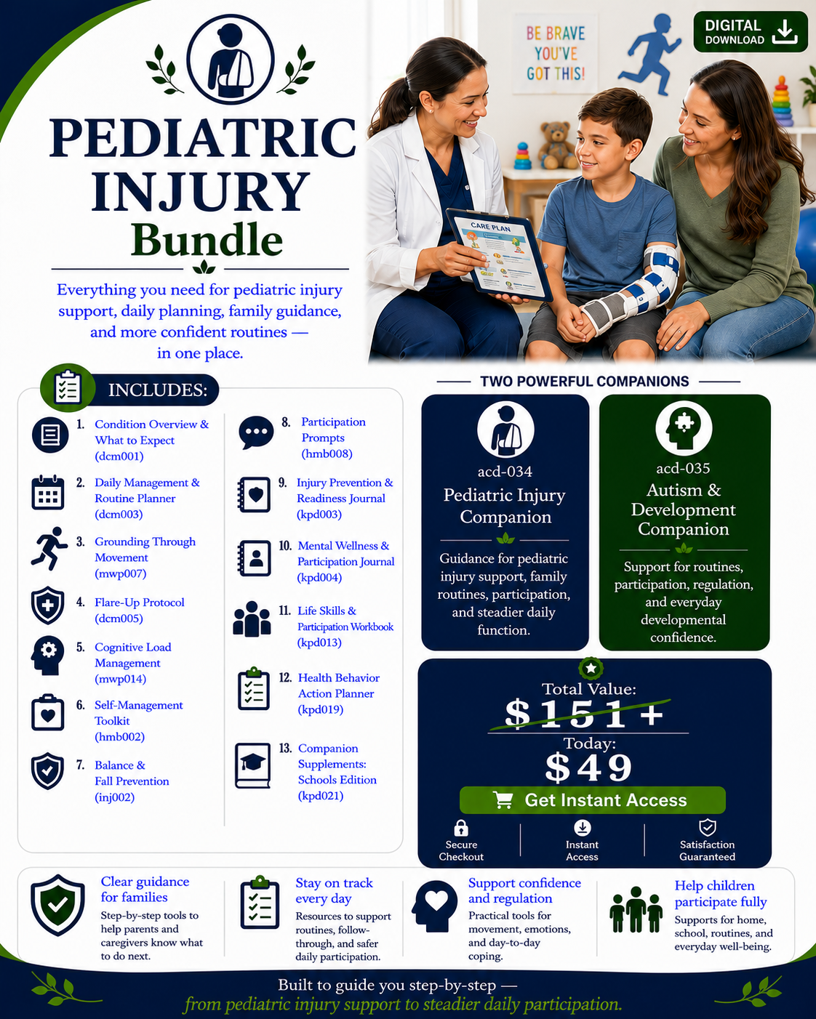
Pediatric Injury Bundle

Bundle

Pediatric Injury Bundle

A focused CarePlanRx™ support resource designed to improve clarity, follow-through, and next-step confidence.
Format digital
Access $49.00
Item ID bndl-034

Educational support only. This resource complements, not replaces, provider instructions, facility policy, or medical advice.

Item Details

About this resource

Start here

The essentials before you go deeper.

More details

A focused CarePlanRx™ support resource designed to improve clarity, follow-through, and next-step confidence.

Bundle Contents

Included in this bundle

This bundle includes the following companions, guidance resources, and workbook tools from the bundle matrix.

acd-034 Pediatric Injury Companion
acd-035 Autism & Development Companion
dcm001 Condition Overview & What to Expect
dcm003 Daily Management & Routine Planner
mwp007 Grounding Through Movement
dcm005 Flare-Up Protocol
mwp014 Cognitive Load Management
hmb002 Self-Management Toolkit
inj002 Balance & Fall Prevention
hmb008 Participation Prompts
kpd003 Injury Prevention & Readiness Journal
kpd004 Mental Wellness & Participation Journal
kpd013 Life Skills & Participation Workbook
kpd019 Health Behavior Activation Planner
kpd021 Companion Supplements: Schools Edition

Next Step Hub

Your next best move starts here.

Choose the matched bundle, continue with this resource, review connected tools, or check the evidence behind the guidance.

This resource

Continue with this item

Use this path when this resource is the book, guide, or support tool you came for.

Get Access

Clinical Confidence

Evidence behind this resource

40 sources
Evidence-informed

Guidance is connected to the CarePlanRx™ reference database.

AMA-style references

Sources are formatted for clinical review and transparency.

Methodology available

Users can review how references support the resource framework.

View Clinical Evidence & Methodology

View clinical references 40 sources
  1. Hadland SE, Agarwal R, Becker WC, et al. Opioid prescribing for acute pain management in children and adolescents in outpatient settings: clinical practice guideline. Pediatrics. 2024;154(5):e2024068752. doi:10.1542/peds.2024-068752 Source
  2. Patten KK, Murthi K, Onwumere DD, et al. Occupational therapy practice guidelines for autistic people across the lifespan. American Journal of Occupational Therapy. 2024;78(3):7803397010. https://research.aota.org/ajot/article/78/3/7803397010/25188/Occupational-Therapy-Practice-Guidelines-for Source
  3. Davis GA, Anderson V, Babl FE, et al. Pediatric sport-related concussion: recommendations from the Amsterdam Consensus Statement 2023. Pediatrics. 2024;153(1):e2023063489. doi:10.1542/peds.2023-063489 Source
  4. National Institute for Health and Care Excellence. Autism spectrum disorder in adults: diagnosis and management. NICE guideline CG142. NICE Guideline. 2012;CG142; last updated June 14, 2021; last reviewed September 5, 2025. https://www.nice.org.uk/guidance/cg142 Source
  5. National Institute for Health and Care Excellence. Fractures (non-complex): assessment and management. NICE guideline NG38. NICE Guideline. 2016;NG38; last reviewed June 23, 2025. https://www.nice.org.uk/guidance/ng38 Source
  6. National Institute for Health and Care Excellence. Autism spectrum disorder in under 19s: support and management. NICE guideline CG170. NICE Guideline. 2013;CG170; last updated June 14, 2021. https://www.nice.org.uk/guidance/cg170 Source
  7. American Academy of Orthopaedic Surgeons. Treatment of pediatric diaphyseal femur fractures: evidence-based clinical practice guideline. American Academy of Orthopaedic Surgeons Clinical Practice Guideline. 2020;Published December 5, 2020. https://www.aaos.org/globalassets/quality-and-practice-resources/pdff/treatment-of-pediatric-diaphyseal-femur-fractures-2020.pdf Source
  8. National Institute for Health and Care Excellence. Autism spectrum disorder in under 19s: recognition, referral and diagnosis. NICE guideline CG128. NICE Guideline. 2011;CG128; last updated December 20, 2017. https://www.nice.org.uk/guidance/cg128 Source
  9. American Academy of Orthopaedic Surgeons. Forearm fractures in children. OrthoInfo. 2024. https://orthoinfo.aaos.org/en/diseases--conditions/forearm-fractures-in-children/ Source
  10. American Occupational Therapy Association. Occupational Therapy Practice Framework: Domain and Process—Fourth Edition. American Journal of Occupational Therapy. 2020;74(Suppl 2):7412410010p1-7412410010p87. doi:10.5014/ajot.2020.74S2001 Source
  11. American Academy of Pediatrics. Concussion. American Academy of Pediatrics Professional Tools and Resources. 2025. https://www.aap.org/en/patient-care/concussion/ Source
  12. World Health Organization. Autism. World Health Organization Fact Sheet. 2025;Updated September 17, 2025. https://www.who.int/news-room/fact-sheets/detail/autism-spectrum-disorders Source
  13. Centers for Disease Control and Prevention. About Autism Spectrum Disorder. Centers for Disease Control and Prevention. 2026;Updated April 13, 2026. https://www.cdc.gov/autism/about/index.html Source
  14. National Athletic Trainers Association. National Athletic Trainers Association position statement: management of sport-related concussion. Journal of Athletic Training. 2024. https://www.nata.org/professional-interests/health-care-topics/concussion Source
  15. Wong CM, Chen YJ, Lee LC, et al. 2023 clinical practice guidelines on autism spectrum disorder in children and adolescents in Singapore. Annals Academy of Medicine Singapore. 2024. https://annals.edu.sg/2023-clinical-practice-guidelines-on-autism-spectrum-disorder-in-children-and-adolescents-in-singapore/ Source
  16. American Occupational Therapy Association. Occupational Therapy Practice Framework: Domain and Process—Fourth Edition. American Journal of Occupational Therapy. 2020;74(Suppl 2):7412410010p1-7412410010p87. doi:10.5014/ajot.2020.74S2001 Source
  17. Chen Y, Xi Z, Saunders R, Simmons D, Totsika V, Mandy W. A systematic review and meta-analysis of the relationship between sensory processing differences and internalising/externalising problems in autism. Clinical Psychology Review. 2024;112:102516. doi:10.1016/j.cpr.2024.102516 Source
  18. Novak I, Morgan C, Fahey M, et al. State of the evidence traffic lights 2019: systematic review of interventions for preventing and treating children with cerebral palsy. Current Neurology and Neuroscience Reports. 2020;20(2):3. doi:10.1007/s11910-020-1022-z Source
  19. Patil O, Madaan V, Ares G, et al. Sensory processing differences in individuals with autism spectrum disorder: a narrative review. Cureus. 2023;15(10):e47052. doi:10.7759/cureus.47052 Source
  20. World Health Organization. Guidelines on physical activity, sedentary behaviour and sleep for children under 5 years of age. World Health Organization Guideline. 2019. https://www.who.int/publications/i/item/9789241550536 Source
  21. Spielmann V, Brown T, Mailloux Z. Linking sensory integration and processing with mental health in autistic adolescents and adults. American Journal of Occupational Therapy. 2023;77(5):7705205160. doi:10.5014/ajot.2023.050127 Source
  22. World Health Organization. WHO guidelines on physical activity and sedentary behaviour. World Health Organization Guideline. 2020. https://www.who.int/publications/i/item/9789240015128 Source
  23. Bull FC, Al-Ansari SS, Biddle S, et al. World Health Organization 2020 guidelines on physical activity and sedentary behaviour. British Journal of Sports Medicine. 2020;54(24):1451-1462. doi:10.1136/bjsports-2020-102955 Source
  24. Crasta JE, Davies PL, Gavin WJ. Sensory processing mediates the relationship between attention and social responsiveness in young adults with and without autism spectrum disorders. American Journal of Occupational Therapy. 2020;74(4_Supplement_1):7411505064p1. https://u.osu.edu/neurolab/publications/ Source
  25. Lord C, Brugha TS, Charman T, et al. Autism spectrum disorder. Nature Reviews Disease Primers. 2020;6:5. doi:10.1038/s41572-019-0138-4 Source
  26. Logan K, Cuff S; Council on Sports Medicine and Fitness. Organized sports for children, preadolescents, and adolescents. Pediatrics. 2019;143(6):e20190997. doi:10.1542/peds.2019-0997 Source
  27. Hyman SL, Levy SE, Myers SM; Council on Children With Disabilities, Section on Developmental and Behavioral Pediatrics. Identification, evaluation, and management of children with autism spectrum disorder. Pediatrics. 2020;145(1):e20193447. doi:10.1542/peds.2019-3447 Source
  28. Purcell L, Micheli L. Low back pain in young athletes. Sports Health. 2009;1(3):212-222. doi:10.1177/1941738109334212 Source
  29. Mason D, Ingham B, Urbanowicz A, et al. A systematic review of what barriers and facilitators prevent and enable physical healthcare services access for autistic adults. Journal of Autism and Developmental Disorders. 2019;49(8):3387-3400. doi:10.1007/s10803-019-04049-2 Source
  30. Bain GI, Polites N, Higgs BG, Heptinstall RJ, McGrath AM. The functional range of motion of the finger joints. Journal of Hand Surgery American Volume. 2015;40(2):406-411. doi:10.1016/j.jhsa.2014.10.017 Source
  31. Nicolaidis C, Raymaker DM, McDonald KE, et al. The development and evaluation of an online healthcare toolkit for autistic adults and their primary care providers. Journal of General Internal Medicine. 2016;31(10):1180-1189. doi:10.1007/s11606-016-3763-6 Source
  32. Kozin SH. Upper-extremity pediatric injuries. Journal of Bone and Joint Surgery American Volume. 2014;96(2):e16. doi:10.2106/JBJS.M.01075 Source
  33. Dreyer Gillette ML, Borner KB, Nadler CB, Poppert KM, Odar Stough C, Swinburne Romine RS. Prevalence and health correlates of overweight and obesity in children with autism spectrum disorder. Journal of Developmental and Behavioral Pediatrics. 2015;36(7):489-496. doi:10.1097/DBP.0000000000000198 Source
  34. Bae DS. Pediatric distal radius and forearm fractures. Journal of Hand Surgery American Volume. 2008;33(10):1911-1923. doi:10.1016/j.jhsa.2008.10.013 Source
  35. McCarty EC, Marx RG, Maerz D, Altchek D, Warren RF. Physical therapy and rehabilitation after anterior cruciate ligament reconstruction in pediatric and adolescent patients. Journal of Pediatric Orthopaedics. 2019;39(1):e22-e28. https://pubmed.ncbi.nlm.nih.gov/30234520/ Source
  36. Richdale AL, Schreck KA. Sleep problems in autism spectrum disorders: prevalence, nature, and possible biopsychosocial aetiologies. Sleep Medicine Reviews. 2009;13(6):403-411. doi:10.1016/j.smrv.2009.02.003 Source
  37. Kraus R, Schneidmuller D, Röder C. Pediatric orthopedic injuries: principles of treatment and rehabilitation. Der Unfallchirurg. 2017;120(5):402-414. https://pubmed.ncbi.nlm.nih.gov/28466193/ Source
  38. Taylor JL, Henninger NA. Frequency and correlates of service access among youth with autism transitioning to adulthood. Journal of Autism and Developmental Disorders. 2015;45(1):179-191. doi:10.1007/s10803-014-2203-x Source
  39. National Autistic Society. What is autism?. National Autistic Society. 2026. https://www.autism.org.uk/advice-and-guidance/what-is-autism Source
  40. Centers for Disease Control and Prevention. HEADS UP to youth sports: online concussion training and resources. Centers for Disease Control and Prevention. 2025. https://www.cdc.gov/heads-up/ Source

CarePlanRx™

Clarity that travels with you.

CarePlanRx™ resources are designed to complement provider instructions, improve follow-through, and help people ask better questions at the right time.