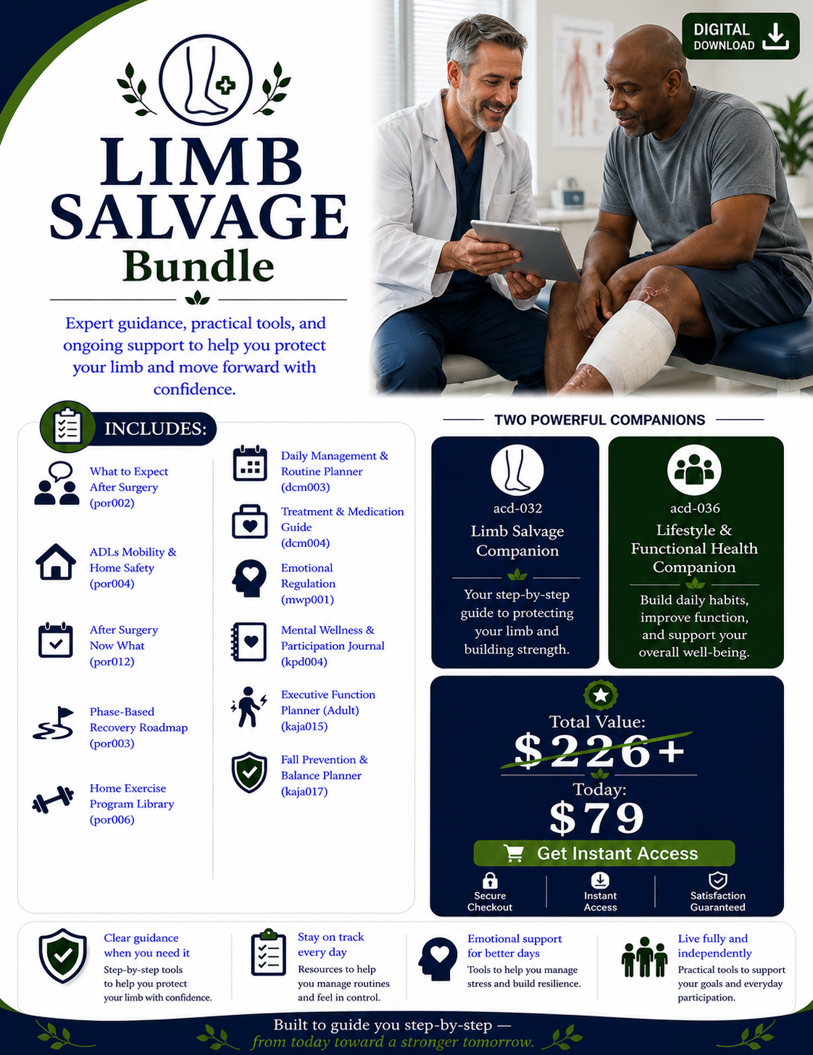
Limb Salvage Bundle

Bundle

Limb Salvage Bundle

A focused CarePlanRx™ support resource designed to improve clarity, follow-through, and next-step confidence.
Format digital
Access $129.00
Item ID bndl-032

Educational support only. This resource complements, not replaces, provider instructions, facility policy, or medical advice.

Item Details

About this resource

Start here

The essentials before you go deeper.

More details

A focused CarePlanRx™ support resource designed to improve clarity, follow-through, and next-step confidence.

Bundle Contents

Included in this bundle

This bundle includes the following companions, guidance resources, and workbook tools from the bundle matrix.

acd-032 Limb Salvage Companion
acd-033 Prosthetic Rehabilitation Companion
dcm001 Condition Overview & What to Expect
dcm002 Symptom Guide & Red Flags
inj002 Balance & Fall Prevention
dcm005 Flare-Up Protocol
mwp003 Pain Neuroscience
hmb003 Long-Term Planning
mwp004 Motivation & Engagement
por007 Assistive Devices & Equipment Guide
kpd005 Health Management & Behavior Journal
kpd018 Return-to-Work Conditioning Log
kpd010 Sleep Reset Workbook
kpd007 Emotional Regulation Workbook
kpd014 Navigating Tough Days Workbook

Next Step Hub

Your next best move starts here.

Choose the matched bundle, continue with this resource, review connected tools, or check the evidence behind the guidance.

This resource

Continue with this item

Use this path when this resource is the book, guide, or support tool you came for.

Get Access

Clinical Confidence

Evidence behind this resource

40 sources
Evidence-informed

Guidance is connected to the CarePlanRx™ reference database.

AMA-style references

Sources are formatted for clinical review and transparency.

Methodology available

Users can review how references support the resource framework.

View Clinical Evidence & Methodology

View clinical references 40 sources
  1. Gornik HL, Aronow HD, Goodney PP, et al. 2024 ACC/AHA/AACVPR/APMA/ABC/SCAI/SVM/SVN/SVS/SIR/VESS Guideline for the Management of Lower Extremity Peripheral Artery Disease. Circulation. 2024. doi:10.1161/CIR.0000000000001251 Source
  2. U.S. Department of Veterans Affairs; U.S. Department of Defense. VA/DoD Clinical Practice Guideline for Rehabilitation of Individuals with Lower Limb Amputation. VA/DoD Clinical Practice Guideline. 2024;Version 3.0; December 2024. https://www.healthquality.va.gov/guidelines/Rehab/amp/LLA-CPG_2024-Guideline_final_20250110.pdf Source
  3. U.S. Department of Veterans Affairs; U.S. Department of Defense. VA/DoD Clinical Practice Guideline for the Management of Upper Limb Amputation Rehabilitation. VA/DoD Clinical Practice Guideline. 2022. https://asht.org/sites/asht/files/images/International/March%202024/VADoD%20CPG%20Management%20of%20Upper%20Limb%20Amputation.pdf Source
  4. Conte MS, Bradbury AW, Kolh P, et al. Global vascular guidelines on the management of chronic limb-threatening ischemia. Journal of Vascular Surgery. 2019;69(6S):3S-125S.e40. doi:10.1016/j.jvs.2019.02.016 Source
  5. U.S. Department of Veterans Affairs; U.S. Department of Defense. VA/DoD Clinical Practice Guideline for Rehabilitation of Individuals with Lower Limb Amputation: Provider Summary. VA/DoD Provider Summary. 2025;January 2025. https://www.healthquality.va.gov/guidelines/Rehab/amp/LLA-CPG_2024-Provider-Summary_final_20250110.pdf Source
  6. Schaper NC, van Netten JJ, Apelqvist J, et al. Practical guidelines on the prevention and management of diabetes-related foot disease: IWGDF 2023 update. Diabetes/Metabolism Research and Reviews. 2024;40(3):e3657. doi:10.1002/dmrr.3657 Source
  7. Bus SA, Sacco ICN, Monteiro-Soares M, et al. Guidelines on the prevention of foot ulcers in persons with diabetes: IWGDF 2023 update. Diabetes/Metabolism Research and Reviews. 2024;40(3):e3651. doi:10.1002/dmrr.3651 Source
  8. Johnson SS, Mansfield E. Prosthetic training: upper limb. Physical Medicine and Rehabilitation Clinics of North America. 2014;25(1):133-151. doi:10.1016/j.pmr.2013.09.007 Source
  9. Bus SA, Armstrong DG, Crews RT, et al. Guidelines on offloading foot ulcers in persons with diabetes: IWGDF 2023 update. Diabetes/Metabolism Research and Reviews. 2024;40(3):e3647. doi:10.1002/dmrr.3647 Source
  10. Soyer K. The importance of rehabilitation concerning upper extremity amputees: a systematic review. Journal of Physical Therapy Science. 2016;28(4):1312-1319. doi:10.1589/jpts.28.1312 Source
  11. Lazzarini PA, Jarl G, Gooday C, et al. Effectiveness of offloading interventions to heal foot ulcers in persons with diabetes: a systematic review and meta-analysis. Diabetes/Metabolism Research and Reviews. 2024;40(3):e3652. doi:10.1002/dmrr.3652 Source
  12. Crerar E, et al. Therapy and rehabilitation in maximizing upper extremity prosthetic outcomes. Hand Clinics. 2023;39(3):347-359. https://www.sciencedirect.com/science/article/abs/pii/S1048666623000423 Source
  13. Senneville E, Albalawi Z, van Asten SA, et al. IWGDF/IDSA guidelines on the diagnosis and treatment of diabetes-related foot infections. Clinical Infectious Diseases. 2023;77(12):e1-e13. doi:10.1093/cid/ciad527 Source
  14. Jang CH, Yang HS, Yang HE, et al. A survey on activities of daily living and occupations of upper extremity amputees. Annals of Rehabilitation Medicine. 2011;35(6):907-921. doi:10.5535/arm.2011.35.6.907 Source
  15. Hinchliffe RJ, Forsythe RO, Apelqvist J, et al. Guidelines on diagnosis, prognosis, and management of peripheral artery disease in patients with foot ulcers and diabetes: IWGDF 2023 update. Diabetes/Metabolism Research and Reviews. 2024;40(3). https://iwgdfguidelines.org/wp-content/uploads/2023/07/IWGDF-2023-05-PAD-Guideline.pdf Source
  16. Segura D, et al. Upper limb prostheses by the level of amputation. Biomechanics. 2024;6(2):22. https://www.mdpi.com/2673-1592/6/2/22 Source
  17. Armstrong DG, Tan TW, Boulton AJM, Bus SA. Diabetic foot ulcers: a review. JAMA. 2023;330(1):62-75. doi:10.1001/jama.2023.10578 Source
  18. Gailey R, Gaunaurd I, Raya M, et al. Effectiveness of an evidence-based amputee rehabilitation program: a pilot randomized controlled trial. Physical Therapy. 2020;100(5):773-787. doi:10.1093/ptj/pzz178 Source
  19. Wukich DK, Schaper NC, Gooday C, et al. Guidelines on the diagnosis and treatment of active Charcot neuro-osteoarthropathy in persons with diabetes mellitus: IWGDF 2023. Diabetes/Metabolism Research and Reviews. 2024;40(3). https://iwgdfguidelines.org/guidelines-2023/ Source
  20. Highsmith MJ, Andrews CR, Millman C, et al. Gait training interventions for lower extremity amputees: a systematic literature review. Technology and Innovation. 2016;18(2-3):99-113. doi:10.21300/18.2-3.2016.99 Source
  21. Chang S, et al. Effects of exercise on physical performance and quality of life in individuals with lower-limb amputation: a systematic review and meta-analysis. Healthcare. 2025. https://pmc.ncbi.nlm.nih.gov/articles/PMC12523202/ Source
  22. Kumbhar S, et al. Advancements and best practices in diabetic foot care. Diabetes Research and Clinical Practice. 2024. https://www.sciencedirect.com/science/article/abs/pii/S0168822724007551 Source
  23. Pelzer D, et al. Outcomes of patients with lower limb loss after using a training prosthesis during rehabilitation. Healthcare. 2024;12(5):567. doi:10.3390/healthcare12050567 Source
  24. van Kouswijk HW, et al. Therapeutic validity and effectiveness of exercise interventions after lower limb-salvage surgery: a systematic review. Disability and Rehabilitation. 2023. https://pmc.ncbi.nlm.nih.gov/articles/PMC10035240/ Source
  25. van Kouswijk HW, et al. Factors influencing functional recovery after limb-salvage surgery: a qualitative study. Disability and Rehabilitation. 2025. doi:10.1080/09638288.2024.2383832 Source
  26. Ghai S, et al. Reporting of rehabilitation outcomes in the traumatic lower limb amputation literature: a systematic review. Archives of Physical Medicine and Rehabilitation. 2024. https://www.archives-pmr.org/article/S0003-9993(23)00522-1/fulltext Source
  27. Rich TL, et al. Occupational therapy as integral partner in lower limb amputation care and future research. Archives of Rehabilitation Research and Clinical Translation. 2025. https://pmc.ncbi.nlm.nih.gov/articles/PMC12715689/ Source
  28. McKenzie C, et al. Occupational therapy rehabilitation for sarcoma patients following limb salvage surgery: a scoping review. Disability and Rehabilitation. 2019. https://ora.ox.ac.uk/objects/uuid%3A2db7ad38-0c44-4891-a37b-2c0bff661918/files/m81df07969435907dd11e45f57017fa42 Source
  29. Rich TL, et al. Occupational therapy as integral partner in lower limb amputation care and future research. Archives of Rehabilitation Research and Clinical Translation. 2025. https://pmc.ncbi.nlm.nih.gov/articles/PMC12715689/ Source
  30. American Occupational Therapy Association. Occupational Therapy Practice Framework: Domain and Process—Fourth Edition. American Journal of Occupational Therapy. 2020;74(Suppl 2):7412410010p1-7412410010p87. doi:10.5014/ajot.2020.74S2001 Source
  31. Fields B, Smallfield S, Marc-Aurele J, et al. Occupational therapy practice guidelines for adults with chronic conditions. American Journal of Occupational Therapy. 2022;76(2):7602397010. https://research.aota.org/ajot/article/76/2/7602397010/23263/Occupational-Therapy-Practice-Guidelines-for Source
  32. American Occupational Therapy Association. Occupational Therapy Practice Framework: Domain and Process—Fourth Edition. American Journal of Occupational Therapy. 2020;74(Suppl 2):7412410010p1-7412410010p87. doi:10.5014/ajot.2020.74S2001 Source
  33. Fields B, Smallfield S, Marc-Aurele J, et al. Occupational therapy practice guidelines for adults with chronic conditions. American Journal of Occupational Therapy. 2022;76(2):7602397010. https://research.aota.org/ajot/article/76/2/7602397010/23263/Occupational-Therapy-Practice-Guidelines-for Source
  34. Limakatso K, Bedwell GJ, Madden VJ, Parker R. The prevalence and risk factors for phantom limb pain in people with amputations: a systematic review and meta-analysis. PLoS One. 2020;15(10):e0240431. doi:10.1371/journal.pone.0240431 Source
  35. Smallfield S, Fang L, Kyler D. Self-management interventions to improve activities of daily living and rest and sleep for adults with chronic conditions: a systematic review. American Journal of Occupational Therapy. 2021;75(4):7504190010. doi:10.5014/ajot.2021.046946 Source
  36. Meulenbelt HEJ, Geertzen JHB, Jonkman MF, Dijkstra PU. Skin problems of the stump in lower limb amputees: a clinical study. Acta Dermato-Venereologica. 2011;91(2):173-177. doi:10.2340/00015555-1023 Source
  37. American College of Foot and Ankle Surgeons. Clinical practice guideline for limb salvage in severe lower extremity trauma. American College of Foot and Ankle Surgeons Guideline. 2018. https://www.aofas.org/docs/default-source/research-and-policy/appropriate-use-citeria-clinical-practice-guidelines/clinical-practice-guideline-for-limb.pdf Source
  38. Miller WC, Speechley M, Deathe B. The prevalence and risk factors of falling and fear of falling among lower extremity amputees. Archives of Physical Medicine and Rehabilitation. 2001;82(8):1031-1037. doi:10.1053/apmr.2001.24295 Source
  39. Society for Vascular Surgery. Patients with chronic limb-threatening ischemia: who to refer. Society for Vascular Surgery. 2024. https://vascular.org/patients-and-referring-physicians/referring-physicians/who-refer/patients-chronic-limb-threatening Source
  40. Balk EM, Gazula A, Markozannes G, et al. Lower limb prostheses: measurement instruments, comparison of component effects by subgroups, and long-term outcomes. AHRQ Comparative Effectiveness Review. 2018;Comparative Effectiveness Review No. 213. https://effectivehealthcare.ahrq.gov/products/lower-limb-prostheses/research Source

CarePlanRx™

Clarity that travels with you.

CarePlanRx™ resources are designed to complement provider instructions, improve follow-through, and help people ask better questions at the right time.