Parkinsons Bundle

Bundle

Parkinsons Bundle

A focused CarePlanRx™ support resource designed to improve clarity, follow-through, and next-step confidence.
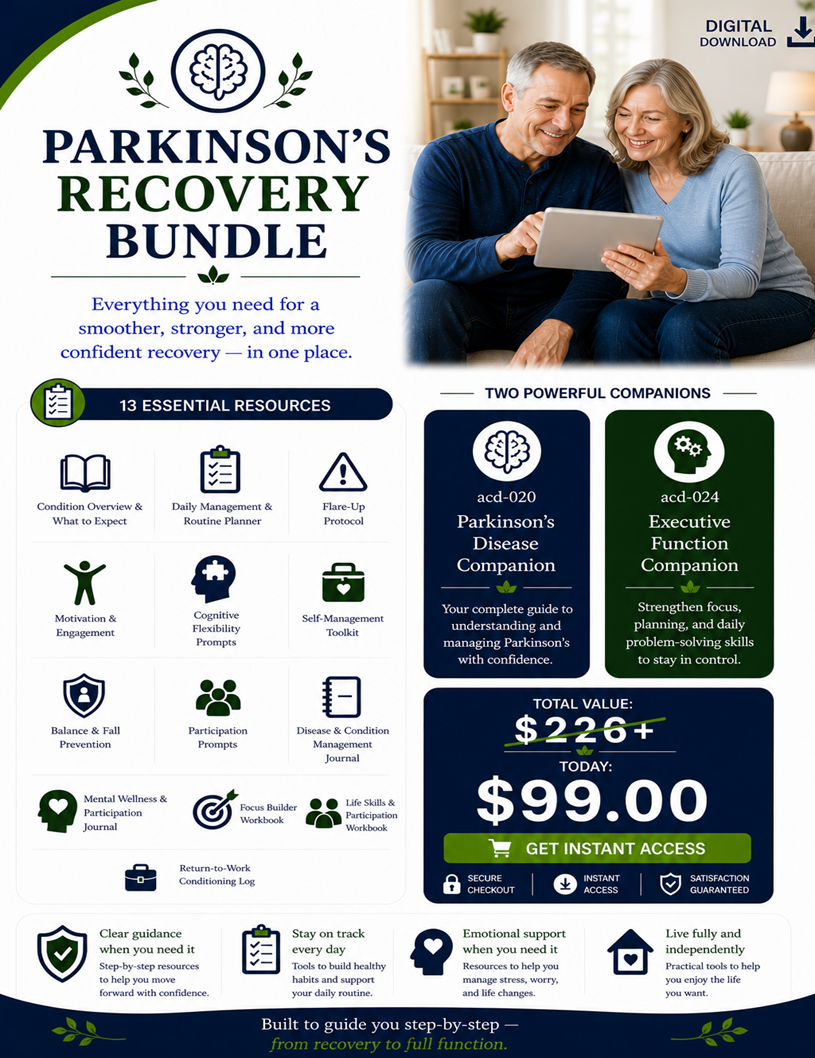
Format digital
Access $99.00
Item ID bndl-020

Educational support only. This resource complements, not replaces, provider instructions, facility policy, or medical advice.

Item Details

About this resource

Start here

The essentials before you go deeper.

More details

A focused CarePlanRx™ support resource designed to improve clarity, follow-through, and next-step confidence.

Bundle Contents

Included in this bundle

This bundle includes the following companions, guidance resources, and workbook tools from the bundle matrix.

acd-020 Parkinson’s Management Companion
acd-024 Executive Function Companion
dcm001 Condition Overview & What to Expect
dcm003 Daily Management & Routine Planner
dcm005 Flare-Up Protocol
mwp004 Motivation & Engagement
mwp016 Cognitive Flexibility Prompts
hmb002 Self-Management Toolkit
inj002 Balance & Fall Prevention
hmb006 Habit Tracker
kpd002 Disease & Condition Management Journal
kpd004 Mental Wellness & Participation Journal
kpd015 Executive Function Planner (Adult)
kpd013 Life Skills & Participation Workbook
kpd018 Return-to-Work Conditioning Log

Next Step Hub

Your next best move starts here.

Choose the matched bundle, continue with this resource, review connected tools, or check the evidence behind the guidance.

This resource

Continue with this item

Use this path when this resource is the book, guide, or support tool you came for.

Get Access

Clinical Confidence

Evidence behind this resource

40 sources
Evidence-informed

Guidance is connected to the CarePlanRx™ reference database.

AMA-style references

Sources are formatted for clinical review and transparency.

Methodology available

Users can review how references support the resource framework.

View Clinical Evidence & Methodology

View clinical references 40 sources
  1. American Speech-Language-Hearing Association. Executive function deficits. ASHA Practice Portal. 2025. https://www.asha.org/practice-portal/clinical-topics/executive-function-deficits/ Source
  2. National Institute for Health and Care Excellence. Parkinson's disease in adults. NICE Guideline NG71. 2017;Last reviewed 2022. https://www.nice.org.uk/guidance/ng71 Source
  3. American Occupational Therapy Association. Functional cognition. American Occupational Therapy Association. 2025. https://www.aota.org/practice/clinical-topics/functional-cognition Source
  4. Armstrong MJ, Okun MS. Diagnosis and treatment of Parkinson disease: a review. JAMA. 2020;323(6):548-560. doi:10.1001/jama.2019.22360 Source
  5. Jeffay E, et al. INCOG 2.0 guidelines for cognitive rehabilitation following traumatic brain injury, Part III: executive functions. Journal of Head Trauma Rehabilitation. 2023;38(1):28-47. https://journals.lww.com/headtraumarehab/fulltext/2023/01000/incog_2_0_guidelines_for_cognitive_rehabilitation.5.aspx Source
  6. Seppi K, Ray Chaudhuri K, Coelho M, et al. Update on treatments for nonmotor symptoms of Parkinson's disease: an evidence-based medicine review. Movement Disorders. 2019;34(2):180-198. doi:10.1002/mds.27602 Source
  7. Ponsford J, et al. INCOG 2.0 guidelines for cognitive rehabilitation following traumatic brain injury, Part II: attention and information processing speed. Journal of Head Trauma Rehabilitation. 2023;38(1):15-27. https://pubmed.ncbi.nlm.nih.gov/36594857/ Source
  8. Fox SH, Katzenschlager R, Lim SY, et al. International Parkinson and Movement Disorder Society evidence-based medicine review: update on treatments for the motor symptoms of Parkinson's disease. Movement Disorders. 2018;33(8):1248-1266. doi:10.1002/mds.27372 Source
  9. Parkinson's Foundation. What is Parkinson's?. Parkinson's Foundation. 2025. https://www.parkinson.org/understanding-parkinsons/what-is-parkinsons Source
  10. Kennedy MRT, et al. INCOG 2.0 guidelines for cognitive rehabilitation following traumatic brain injury, Part V: memory. Journal of Head Trauma Rehabilitation. 2023;38(1):66-85. https://pubmed.ncbi.nlm.nih.gov/36594860/ Source
  11. American Parkinson Disease Association. Medication management in Parkinson's disease. American Parkinson Disease Association. 2025. https://www.apdaparkinson.org/article/timing-medication-parkinsons-disease/ Source
  12. Velikonja D, et al. INCOG 2.0 guidelines for cognitive rehabilitation following traumatic brain injury, Part IV: cognitive-communication and social cognition disorders. Journal of Head Trauma Rehabilitation. 2023;38(1):48-65. https://pubmed.ncbi.nlm.nih.gov/36594859/ Source
  13. Michael J. Fox Foundation. Parkinson's 360: medication and on-off periods. Michael J. Fox Foundation. 2025. https://www.michaeljfox.org/news/ask-md-medication-wearing Source
  14. Cicerone KD, Goldin Y, Ganci K, et al. Evidence-based cognitive rehabilitation: systematic review of the literature from 2009 through 2014. Archives of Physical Medicine and Rehabilitation. 2019;100(8):1515-1533. doi:10.1016/j.apmr.2019.02.011 Source
  15. Osborne JA, Botkin R, Colon-Semenza C, et al. Physical therapist management of Parkinson disease: a clinical practice guideline from the American Physical Therapy Association. Physical Therapy. 2022;102(4):pzab302. doi:10.1093/ptj/pzab302 Source
  16. Toglia J, Foster ER. The multicontext approach to cognitive rehabilitation: a metacognitive strategy intervention to optimize functional cognition. AOTA Press. 2021;2nd edition. https://library.aota.org/AOTA-Press/Product/900520 Source
  17. American Congress of Rehabilitation Medicine Cognitive Rehabilitation Task Force. Cognitive rehabilitation manual: translating evidence-based recommendations into practice. American Congress of Rehabilitation Medicine. 2022;Second edition. https://acrm.org/publications/cognitive-rehabilitation-manual/ Source
  18. Ellis T, Rochester L. Mobilizing Parkinson's disease: the future of exercise. Journal of Parkinson's Disease. 2018;8(s1):S95-S100. doi:10.3233/JPD-181489 Source
  19. Giles GM, Edwards DF, Morrison MT, et al. Screening and assessment of cognitive dysfunction in adults with traumatic brain injury: a systematic review. American Journal of Occupational Therapy. 2020;74(2):7402205010p1-7402205010p14. doi:10.5014/ajot.2020.038182 Source
  20. Tomlinson CL, Herd CP, Clarke CE, et al. Physiotherapy for Parkinson's disease: a comparison of techniques. Cochrane Database of Systematic Reviews. 2014;Issue 6:CD002815. doi:10.1002/14651858.CD002815.pub2 Source
  21. Giles GM, Edwards DF, Morrison MT, et al. Intervention for cognitive dysfunction in adults with traumatic brain injury: a systematic review. American Journal of Occupational Therapy. 2020;74(2):7402205020p1-7402205020p9. doi:10.5014/ajot.2020.038190 Source
  22. Nieuwboer A, Rochester L, Müncks L, Swinnen SP. Motor learning in Parkinson's disease: limitations and potential for rehabilitation. Parkinsonism & Related Disorders. 2009;15 Suppl 3:S53-S58. doi:10.1016/S1353-8020(09)70781-3 Source
  23. Kofler MJ, et al. Executive function deficits in attention-deficit/hyperactivity disorder and autism spectrum disorder. Clinical Child and Family Psychology Review. 2024. https://pmc.ncbi.nlm.nih.gov/articles/PMC11485171/ Source
  24. Sturkenboom IHWM, Graff MJL, Hendriks JCM, et al. Efficacy of occupational therapy for patients with Parkinson's disease: a randomised controlled trial. The Lancet Neurology. 2014;13(6):557-566. doi:10.1016/S1474-4422(14)70055-9 Source
  25. American Occupational Therapy Association. Occupational Therapy Practice Framework: Domain and Process—Fourth Edition. American Journal of Occupational Therapy. 2020;74(Suppl 2):7412410010p1-7412410010p87. doi:10.5014/ajot.2020.74S2001 Source
  26. Foster ER, Hershey T. Everyday executive function is associated with activity participation in Parkinson disease. Neurorehabilitation and Neural Repair. 2011;25(8):733-741. doi:10.1177/1545968311418381 Source
  27. Benedict RHB, Amato MP, DeLuca J, Geurts JJG. Cognitive impairment in multiple sclerosis: clinical management, MRI, and therapeutic avenues. Lancet Neurology. 2020;19(10):860-871. doi:10.1016/S1474-4422(20)30277-5 Source
  28. Ramig LO, Sapir S, Countryman S, et al. Intensive voice treatment for patients with Parkinson's disease: a 2 year follow up. Journal of Neurology, Neurosurgery & Psychiatry. 2001;71(4):493-498. doi:10.1136/jnnp.71.4.493 Source
  29. Bakas T, et al. Systematic review of the evidence for stroke family caregiver and dyad interventions. Stroke. 2022. doi:10.1161/STROKEAHA.121.034090 Source
  30. Troche MS, Okun MS, Rosenbek JC, et al. Aspiration and swallowing in Parkinson disease and rehabilitation with EMST: a randomized trial. Neurology. 2010;75(21):1912-1919. doi:10.1212/WNL.0b013e3181fef115 Source
  31. American Speech-Language-Hearing Association. Traumatic brain injury in adults. ASHA Practice Portal. 2025. https://www.asha.org/practice-portal/clinical-topics/traumatic-brain-injury-in-adults/ Source
  32. Aarsland D, Batzu L, Halliday GM, et al. Parkinson disease-associated cognitive impairment. Nature Reviews Disease Primers. 2021;7:47. doi:10.1038/s41572-021-00280-3 Source
  33. American Speech-Language-Hearing Association. Dementia. ASHA Practice Portal. 2025. https://www.asha.org/practice-portal/clinical-topics/dementia/ Source
  34. Ffytche DH, Creese B, Politis M, et al. The psychosis spectrum in Parkinson disease. Nature Reviews Neurology. 2017;13(2):81-95. doi:10.1038/nrneurol.2016.200 Source
  35. American Occupational Therapy Association. Occupational Therapy Practice Framework: Domain and Process—Fourth Edition. American Journal of Occupational Therapy. 2020;74(Suppl 2):7412410010p1-7412410010p87. doi:10.5014/ajot.2020.74S2001 Source
  36. Martinez-Martin P, et al. Parkinson's disease caregiver burden and health-related quality of life. Movement Disorders. 2015;30(7):924-931. doi:10.1002/mds.26275 Source
  37. Smallfield S, Fang L, Kyler D. Self-management interventions to improve activities of daily living and rest and sleep for adults with chronic conditions: a systematic review. American Journal of Occupational Therapy. 2021;75(4):7504190010. doi:10.5014/ajot.2021.046946 Source
  38. Deuschl G, Schade-Brittinger C, Krack P, et al. A randomized trial of deep-brain stimulation for Parkinson's disease. New England Journal of Medicine. 2006;355(9):896-908. doi:10.1056/NEJMoa060281 Source
  39. National Center on Accessible Educational Materials. Executive function and accessible learning supports. CAST / National Center on Accessible Educational Materials. 2025. https://aem.cast.org/ Source
  40. Smallfield S, Fang L, Kyler D. Self-management interventions to improve activities of daily living and rest and sleep for adults with chronic conditions: a systematic review. American Journal of Occupational Therapy. 2021;75(4):7504190010. doi:10.5014/ajot.2021.046946 Source

CarePlanRx™

Clarity that travels with you.

CarePlanRx™ resources are designed to complement provider instructions, improve follow-through, and help people ask better questions at the right time.