Spinal Cord Injury Bundle

Bundle

Spinal Cord Injury Bundle

A focused CarePlanRx™ support resource designed to improve clarity, follow-through, and next-step confidence.
Format digital
Access $99.00
Item ID bndl-019

Educational support only. This resource complements, not replaces, provider instructions, facility policy, or medical advice.

Item Details

About this resource

Start here

The essentials before you go deeper.

More details

A focused CarePlanRx™ support resource designed to improve clarity, follow-through, and next-step confidence.

Bundle Contents

Included in this bundle

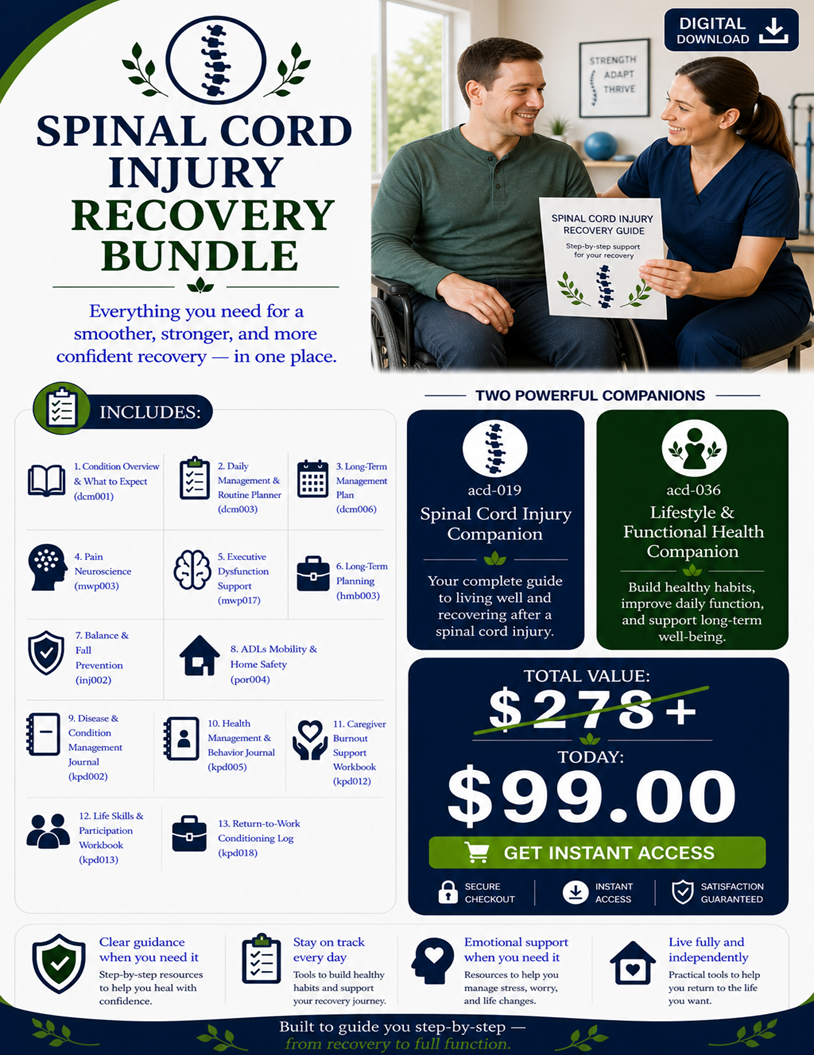
This bundle includes the following companions, guidance resources, and workbook tools from the bundle matrix.

acd-019 Spinal Cord Injury Companion
acd-036 Lifestyle & Functional Health Companion
dcm001 Condition Overview & What to Expect
dcm003 Daily Management & Routine Planner
dcm006 Long-Term Management Plan
mwp003 Pain Neuroscience
mwp017 Executive Dysfunction Support
hmb003 Long-Term Planning
inj002 Balance & Fall Prevention
por004 ADLs Mobility & Home Safety
kpd002 Disease & Condition Management Journal
kpd005 Health Management & Behavior Journal
kpd012 Caregiver Burnout Support Workbook
kpd013 Life Skills & Participation Workbook
kpd018 Return-to-Work Conditioning Log

Next Step Hub

Your next best move starts here.

Choose the matched bundle, continue with this resource, review connected tools, or check the evidence behind the guidance.

This resource

Continue with this item

Use this path when this resource is the book, guide, or support tool you came for.

Get Access

Clinical Confidence

Evidence behind this resource

40 sources
Evidence-informed

Guidance is connected to the CarePlanRx™ reference database.

AMA-style references

Sources are formatted for clinical review and transparency.

Methodology available

Users can review how references support the resource framework.

View Clinical Evidence & Methodology

View clinical references 40 sources
  1. World Health Organization. Spinal cord injury. World Health Organization Fact Sheet. 2024;Published April 16, 2024. https://www.who.int/news-room/fact-sheets/detail/spinal-cord-injury Source
  2. American Occupational Therapy Association. Occupational Therapy Practice Framework: Domain and Process—Fourth Edition. American Journal of Occupational Therapy. 2020;74(Suppl 2):7412410010p1-7412410010p87. doi:10.5014/ajot.2020.74S2001 Source
  3. Consortium for Spinal Cord Medicine; Paralyzed Veterans of America. Clinical practice guidelines for spinal cord injury. Paralyzed Veterans of America Clinical Practice Guidelines. 2024;Clinical practice guideline collection. https://pva.org/research-resources/publications/clinical-practice-guidelines/ Source
  4. Fields B, Smallfield S, Marc-Aurele J, et al. Occupational therapy practice guidelines for adults with chronic conditions. American Journal of Occupational Therapy. 2022;76(2):7602397010. https://research.aota.org/ajot/article/76/2/7602397010/23263/Occupational-Therapy-Practice-Guidelines-for Source
  5. Agency for Clinical Innovation. Treatment of autonomic dysreflexia for adults and adolescents with spinal cord injuries. NSW Agency for Clinical Innovation. 2025;March 2025. https://aci.health.nsw.gov.au/__data/assets/pdf_file/0007/155149/ACI-Treatment-of-autonomic-dysreflexia-for-adults-and-adolescents-with-spinal-cord-injuries.pdf Source
  6. Smallfield S, Fang L, Kyler D. Self-management interventions to improve activities of daily living and rest and sleep for adults with chronic conditions: a systematic review. American Journal of Occupational Therapy. 2021;75(4):7504190010. doi:10.5014/ajot.2021.046946 Source
  7. American College of Lifestyle Medicine. What is lifestyle medicine?. American College of Lifestyle Medicine. 2026. https://lifestylemedicine.org/about-lifestyle-medicine/ Source
  8. Consortium for Spinal Cord Medicine; Paralyzed Veterans of America. Evaluation and management of autonomic dysreflexia and other autonomic dysfunctions. Paralyzed Veterans of America Clinical Practice Guideline. 2021;Clinical practice guideline. https://pva.org/research-resources/publications/clinical-practice-guidelines/ Source
  9. Kurze I, et al. Guideline for the management of neurogenic bowel dysfunction in spinal cord injury and disease. Spinal Cord. 2022;60:435-443. doi:10.1038/s41393-022-00786-x Source
  10. Lianov L, Johnson M. Physician competencies for prescribing lifestyle medicine. JAMA. 2010;304(2):202-203. doi:10.1001/jama.2010.903 Source
  11. Consortium for Spinal Cord Medicine; Paralyzed Veterans of America. Management of neurogenic bowel dysfunction in adults after spinal cord injury. Paralyzed Veterans of America Clinical Practice Guideline. 2020;Clinical practice guideline; consumer guide updated 2024. https://pva.org/wp-content/uploads/2024/09/Neurogenic-Bowel-Consumer-Guide-2024-V7.pdf Source
  12. Polak R, Pojednic RM, Phillips EM. Lifestyle medicine education. American Journal of Lifestyle Medicine. 2015;9(5):361-367. doi:10.1177/1559827615580307 Source
  13. Consortium for Spinal Cord Medicine; Paralyzed Veterans of America. Bladder management for adults with spinal cord injury. Paralyzed Veterans of America Clinical Practice Guideline. 2021;Clinical practice guideline reprint. https://pva.org/research-resources/publications/clinical-practice-guidelines/ Source
  14. World Health Organization. WHO guidelines on physical activity and sedentary behaviour. World Health Organization Guideline. 2020. https://www.who.int/publications/i/item/9789240015128 Source
  15. Wounds Canada. Prevention and management of pressure injuries in people with spinal cord injury. Wounds Canada / SCIRE Clinical Practice Guideline Resource. 2024;Clinical practice guideline resource. https://scireproject.com/videos-and-toolkits/clinical-practice-guidelines/ Source
  16. Bull FC, Al-Ansari SS, Biddle S, et al. World Health Organization 2020 guidelines on physical activity and sedentary behaviour. British Journal of Sports Medicine. 2020;54(24):1451-1462. doi:10.1136/bjsports-2020-102955 Source
  17. U.S. Department of Health and Human Services. Physical Activity Guidelines for Americans, 2nd edition. U.S. Department of Health and Human Services. 2018. https://health.gov/sites/default/files/2019-09/Physical_Activity_Guidelines_2nd_edition.pdf Source
  18. Consortium for Spinal Cord Medicine; Paralyzed Veterans of America. Pressure ulcer prevention and treatment following spinal cord injury. Paralyzed Veterans of America Clinical Practice Guideline. 2014;Clinical practice guideline. https://pva.org/wp-content/uploads/2021/09/cpg_pressure-ulcer.pdf Source
  19. Consortium for Spinal Cord Medicine; Paralyzed Veterans of America. Evaluation and management of pain after spinal cord injury. Paralyzed Veterans of America Clinical Practice Guideline. 2024;Clinical practice guideline. https://pva.org/research-resources/publications/clinical-practice-guidelines/ Source
  20. Piercy KL, Troiano RP, Ballard RM, et al. The Physical Activity Guidelines for Americans. JAMA. 2018;320(19):2020-2028. doi:10.1001/jama.2018.14854 Source
  21. International Spinal Cord Society. Management of spasticity after spinal cord injury. SCIRE Professional Evidence Resource. 2024;SCIRE Evidence Resource. https://scireproject.com/evidence/spasticity/ Source
  22. U.S. Department of Agriculture; U.S. Department of Health and Human Services. Dietary Guidelines for Americans, 2020-2025. U.S. Department of Agriculture and U.S. Department of Health and Human Services. 2020;9th edition. https://www.dietaryguidelines.gov/resources/2020-2025-dietary-guidelines-online-materials Source
  23. Lichtenstein AH, Appel LJ, Vadiveloo M, et al. 2021 Dietary guidance to improve cardiovascular health: a scientific statement from the American Heart Association. Circulation. 2021;144(23):e472-e487. doi:10.1161/CIR.0000000000001031 Source
  24. Consortium for Spinal Cord Medicine; Paralyzed Veterans of America. Preservation of upper limb function following spinal cord injury. Paralyzed Veterans of America Clinical Practice Guideline. 2021;Clinical practice guideline reprint. https://pva.org/wp-content/uploads/2021/09/cpg_upperlimb.pdf Source
  25. Lloyd-Jones DM, Allen NB, Anderson CAM, et al. Life’s Essential 8: updating and enhancing the American Heart Association’s construct of cardiovascular health. Circulation. 2022;146(5):e18-e43. doi:10.1161/CIR.0000000000001078 Source
  26. Consortium for Spinal Cord Medicine; Paralyzed Veterans of America. Respiratory management following spinal cord injury. Paralyzed Veterans of America Clinical Practice Guideline. 2021;Clinical practice guideline reprint. https://pva.org/wp-content/uploads/2021/09/cpg_resmgmt.pdf Source
  27. Teasell R, et al. Clinical practice guidelines for standing in adults following spinal cord injury. Spinal Cord. 2019;57:1-12. https://scireproject.com/videos-and-toolkits/clinical-practice-guidelines/ Source
  28. Watson NF, Badr MS, Belenky G, et al. Recommended amount of sleep for a healthy adult: a joint consensus statement of the American Academy of Sleep Medicine and Sleep Research Society. Journal of Clinical Sleep Medicine. 2015;11(6):591-592. doi:10.5664/jcsm.4758 Source
  29. Vancouver Coastal Health; GF Strong Rehabilitation Centre. Sexual health after spinal cord injury. Patient and Provider Education Resource. 2024;Clinical education resource. https://askus-resource-center.unitedspinal.org/index.php?id=8&pg=kb.printer.friendly Source
  30. Hirshkowitz M, Whiton K, Albert SM, et al. National Sleep Foundation’s sleep time duration recommendations: methodology and results summary. Sleep Health. 2015;1(1):40-43. doi:10.1016/j.sleh.2014.12.010 Source
  31. United Spinal Association. Health and wellness after SCI/D. United Spinal Association Ask Us Resource Center. 2025. https://askus-resource-center.unitedspinal.org/index.php?id=8&pg=kb.printer.friendly Source
  32. Kim S, Xu Y, Dore K, Gewurtz R, Lariviere N, Letts L. Fatigue self-management led by occupational therapists and/or physiotherapists for chronic conditions: a systematic review and meta-analysis. Chronic Illness. 2022;18(4):781-793. doi:10.1177/17423953211039783 Source
  33. Omura KM, Faria-Fortini I, Polese JC, et al. Energy conservation, minimum steps, and adaptations when using energy conservation strategies: a scoping review. Hong Kong Journal of Occupational Therapy. 2022;35(2):93-107. doi:10.1177/15691861221137223 Source
  34. Nas K, Yazmalar L, Şah V, Aydın A, Öneş K. Rehabilitation of spinal cord injuries. World Journal of Orthopedics. 2015;6(1):8-16. doi:10.5312/wjo.v6.i1.8 Source
  35. American Occupational Therapy Association. Occupational Therapy Practice Framework: Domain and Process—Fourth Edition. American Journal of Occupational Therapy. 2020;74(Suppl 2):7412410010p1-7412410010p87. doi:10.5014/ajot.2020.74S2001 Source
  36. Bodenheimer T, Lorig K, Holman H, Grumbach K. Patient self-management of chronic disease in primary care. JAMA. 2002;288(19):2469-2475. doi:10.1001/jama.288.19.2469 Source
  37. Smallfield S, Fang L, Kyler D. Self-management interventions to improve activities of daily living and rest and sleep for adults with chronic conditions: a systematic review. American Journal of Occupational Therapy. 2021;75(4):7504190010. doi:10.5014/ajot.2021.046946 Source
  38. Lorig KR, Sobel DS, Ritter PL, Laurent D, Hobbs M. Effect of a self-management program on patients with chronic disease. Eff Clin Pract. 2001;4(6):256-262. https://pubmed.ncbi.nlm.nih.gov/11769298/ Source
  39. Kim S, Xu Y, Dore K, Gewurtz R, Lariviere N, Letts L. Fatigue self-management led by occupational therapists and/or physiotherapists for chronic conditions: a systematic review and meta-analysis. Chronic Illness. 2022;18(4):781-793. doi:10.1177/17423953211039783 Source
  40. National Academies of Sciences, Engineering, and Medicine. Social isolation and loneliness in older adults: opportunities for the health care system. National Academies Press. 2020. doi:10.17226/25663 Source

CarePlanRx™

Clarity that travels with you.

CarePlanRx™ resources are designed to complement provider instructions, improve follow-through, and help people ask better questions at the right time.